The Expanded Universe Explains, Vol. V

Thanks once again to Pearlann Porter, my endless font of Star Wars questions.

10. Who was the persuader/catalyst for engaging with Luke, Obi-Wan or Qui-Gon?

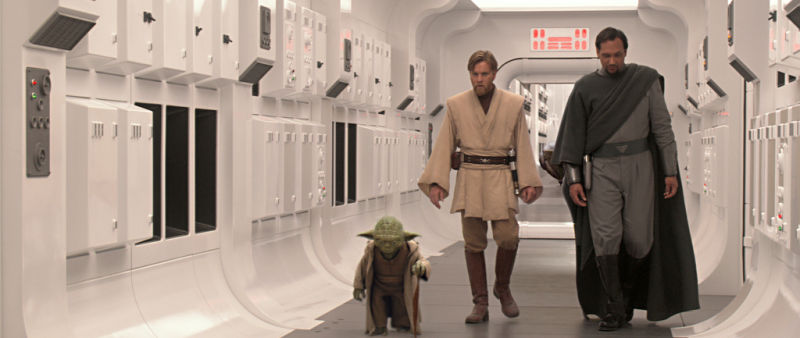
It was the plan all along. As of Revenge of the Sith, Yoda had already been communing with Qui-Gon for some time, so to what extent Qui-Gon talked him into what eventually became The Plan is hard to say. Also hard to say is how Ben would’ve handled Luke had the droids not shown up when they did—it’s hard to imagine him just knocking on the door one day and trying to take Luke off for training.

But what we can say is that training was definitely in the cards all along. The RotS novelization is indispensable in this area, as it’s the best (and basically only) guide for what’s going on in Yoda’s head at the end of the movie. Basically, after proving unable to best Palpatine in their Senate fight, Yoda comes to the realization—again, having been nudged in this direction by Qui-Gon, in all likelihood—that the Jedi Order that he and Obi represent just isn’t equipped to handle the Sith that Sidious and Vader represent.
Read More
Dark Horse Loses the License – Our First Reactions

True story: the first time five of us got together for an Aggressive Negotiations chat, it took over a month to work out the scheduling—some of us had work, some were traveling, and Ben Crofts insisted on being British for some reason. So when the news broke yesterday that the license for Star Wars comics, as many have spent the past year sensibly predicting, would be leaving Dark Horse after this year and coming “home” to fellow Disney property Marvel, it surely must have been fate that most of us were able to get together only about twenty-four hours later to share our thoughts.

We’ll have some more polished reactions in the weeks to come (and don’t miss Becca’s early analysis of the license situation from late last year), but for now, enjoy our decidedly un-polished, un-copy-edited discussion. And cheers to the fine people of Dark Horse Comics for 23 awesome years.


Alexander: So, Marvel it is.

Mike: topic one: fuck

Ben: Plus probably reboot

Mike: that’s a good starting point: does the license switch guarantee a reboot?

Alexander: I don’t think it guarantees it, but I think it’s a very strong indicator of it.

Ben: I think it makes it more likely, yes

Mike: is there any precedent for continuity among competitors?

Jay: It certainly makes it more likely, especially if they want to keep a single universe

Jay: Del Rey / Bantam?

Jay: but Marvel is a different beast.
Read More

Our New Year’s Resolutions for Star Wars in 2014

vaderdove

Welcome to 2014! After a bleak Christmas with no new articles for a whole week, one could be forgiven for submitting to the doldrums. To liven things up and kick off the new year with a bang, I asked the gang to share the resolutions they’d like to see the Star Wars franchise adopt in 2014.

Jay Shah: Don’t Force the Storytelling

Star Wars may well be part fantasy, but the mystic aspect has dominated in the years since the prequels. Whether we’re looking at the books, comics, games, television shows, or even the movies themselves, the Jedi and Sith loom large over Star Wars. Lightsabers and magical powers may well be iconic, but one could be forgiven for imagining that they were the only thing Star Wars was ever known for. Stormtroopers? X-wings? Smugglers? Eh, not a big deal.

There are a handful of releases these past few years that have kept things diversified. Fantasy Flight Game’s Edge of the Empire RPG materials are the best example, as they practically avoid most mentions of the Force except as a fleeting whisper, a myth given credence by rumor more than observation, which fits the game’s OT setting. The Old Republic has multiple character classes as part of its game system, meaning that players are free to diversify, but is dominated by the titanic struggle between Jedi and Sith in the pre-movie eras. As we approach the inauguration of the Sequel Trilogy and Episode VII in particular, the Force will have to play a large role in events: we’ll doubtless see the reëstablishment of the Jedi Order in some fashion or another and we’ll probably see the continuation of the Skywalker story. This is well and good, but Disney mustn’t forget that a large part of what made the OT great was that it featured political struggles — Rebels versus Imperials — or the heroism of the everyman in response to the calling of destiny.
Read More

Classic Star Wars Re-Visited 20 Years Later

Some stories make such a strongly positive impression that you wish to own them but not necessarily rush to re-read them! Classic Star Wars by Archie Goodwin and Al Williamson is one such story. As part of my general upgrade to trades over comics, I secured copies of them some years back but had not read them. I read the issues but that was 20 years ago and I’m certainly not who I was then so how does it look to me now?

Originally published as a newspaper strip from 1982 to 1984, this 3-year tale focused on the then largely vacant gap between A New Hope and The Empire Strikes Back (ESB). In this way it set the tone, perhaps unknowingly, for all subsequent bridging stories, at least up until the Clone Wars material – they wrote it knowing what they were bridging to! Dark Horse Comics decided to re-publish the strip but they wanted to publish it as a monthly comic, in colour. An extensive period of re-formatting and careful colouring followed, as colour could easily obscure the graceful linework by Williamson if done carelessly. The 20-issue series ran from 1992 to 1994, with it being collected into 3 trades in 1996.

Two decades on and I’d estimate that I’ve read around a couple of hundred Star Wars comics in that time, how can a 20-issue series, of material written in the 1980s compare to these? The answer is quite easily because quality is timeless and the one thing no would ever accuse either Goodwin or Williamson of lacking is superb creative skills! It also avoids a couple of pitfalls that older material, at least where the superheroes of Marvel and DC are concerned, regularly fall into.
Read More

Star Wars and Genre: Swashbuckling Adventure

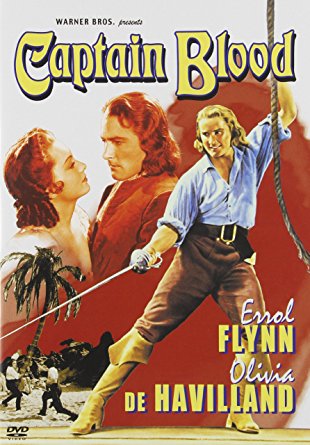
Errol Flynn, king of the swashbucklers, in art for Captain Blood

What is swashbuckling adventure? The term conjures images of dashing heroes rescuing damsels in distress via energetic swordfights in a romantic historical setting. It should be obvious that there is some of this in Star Wars’ DNA: it is dominated by dashing, high-octane heroic adventure, and sometimes openly apes the tropes of swashbucklers. Twice, a lightsaber-armed Luke Skywalker rescues Princess Leia and escapes by swinging across a gap on a rope (it’s not real swashbuckling adventure until somebody swings from a rope, vine, or whip). At its core, Star Wars is a spiritual descendant of swashbuckling adventure, which means the genre should occupy a significant place in the Expanded Universe.

There are certain tropes that go along with the swashbuckler: elaborate fencing-centric action sequences, romance with a damsel in distress, a bold and idealistic hero fighting against oppression or cruelty, a wicked villain in a position of power (who must inevitably be defeated in a swordfight), a historical setting of approximately 1200-1800 (or a fantasy version thereof). Think Robin Hood. But fundamentally, swashbuckling adventure is about an attitude. A swashbuckler’s approach to entertainment is energetic and flamboyant: its characters are larger than life, its plot one of constant thrills and excitement, its tone exuberant. It is almost never in question that the hero will win; the point of the story is to enjoy the fun-packed journey to victory.
Read More