Dark Horse vs Marvel: The Future of the Comics License

A long time ago, in a galaxy not-so-far-away, in 1977, the first Star Wars movie was released…into a world that already had a Star Wars comic. Marvel published Star Wars #1 a month before the movie’s release. Licensed comics have been a part of the franchise since its inception, and while formats, styles and publishers have changed, I don’t see that changing. With the sale of Lucasfilm to Disney, new films pending and the comics industry undergoing a financial recovery, we’re left with a lot of interesting questions about their future…

The History
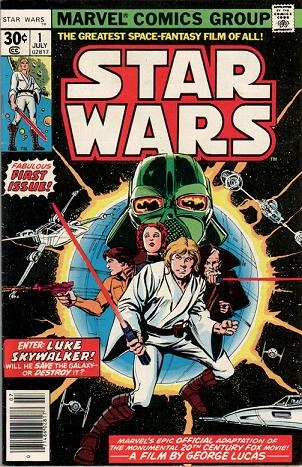
Marvel originally acquired the rights to publish a limited six-issue adaptation of A New Hope, but it sold so extraordinarily well that they pushed for the opportunity to continue publishing it as an ongoing series. The limitations placed on them meant that they were not able to advance the plot or characters in any significant way, but this pushed them towards expanding outwards, introducing new characters and locations. Tonally, the Marvel comics vary wildly from later installations of the Expanded Universe, and it’s true that as a body of work they sit further down the canonical hierarchy, associated with giant green space bunnies and cheesy predictions of doom. But they also introduced characters such as Lumiya, who returned as a serious villain in Del Rey’s recent Legacy of the Force novel series. They introduced a complicated and well-received backstory for the Mandalorians, one that has proven remarkably resilient to retcons as authors keep finding ways to work it back in. John Jackson Miller states that Archie Goodwin’s work on the original Marvel Star Wars series directly inspired plotlines in his much more recent series, Knights of the Old Republic.
Read More
The Best of the Worst—Awesome Stuff in Atrocious EU

Man oh man, the Bantam era. Not having discovered Star Wars until the Special Editions in 1997, I spent the next couple years racing through dozens of already-published novels before catching up to the “present” right around when the New Jedi Order started. As such, those first fifteen years after Return of the Jedi are kind of a blur for me; though I at least had the advantage of reading them mostly in chronological order. I don’t really remember the stories of that era, for the most part, as much as certain distinct moments—Han crashing the Falcon on Kessel. Bib Fortuna’s brain in a jar. Leia hiding from Thrawn on Honoghr. Anakin on Centerpoint Station. Jaina in her cell.

Cell? What cell? Why, on Hethrir’s worldcraft, of course, in The Crystal Star.

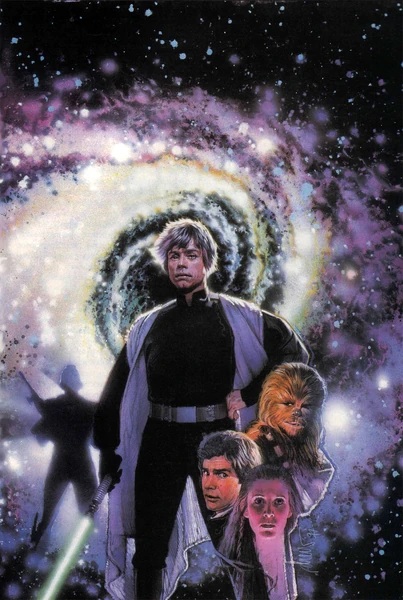
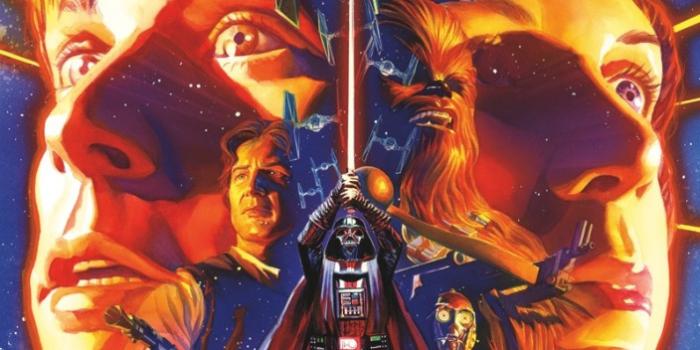
Having abducted all three Solo brats just prior to the opening of the novel (which was admirably in media res of him if nothing else), Hethrir, leader of the Empire Reborn cult, steals away to his worldcraft, which is a spaceship that’s also kind of a planet and…eh, it’s not important. Jacen and Jaina, all of five years old at this point, are locked in separate cells with a bunch of other kids at something of a reeducation camp designed to teach toddlers—the only people who could possibly buy Hethrir’s argument—how great Emperor At least the cover art was pretty in those days.Palpatine was and how thrilled they should all be that Hethrir is bringing evil back. The twins aren’t buying it, of course, and soon enough they lead an exodus with the help of a friendly dragon (no, really).
It’s fairly standard young-reader pablum, really; told well enough, but nothing especially clever or original. Except for one thing.

Hethrir is using the Force to dampen, and monitor, Jacen and Jaina’s still-burgeoning powers; Jaina describes it in her internal monologue as a heavy, wet blanket covering them and preventing them from exerting themselves to escape. So one night in her cell, Jaina starts to experiment—she reaches out to a single air molecule floating in the room. Wiggles it around. Hethrir doesn’t notice. She adds a few more, tries rubbing them together—a light appears! Hethrir still doesn’t notice.
Read More

Politics and the Expanded Universe (Part III) — The Galactic Empire

Today, we talk about the Galactic Empire. Always popular, either as a villain or by Imperial fans in general, the Empire’s making a rather splashy comeback as the primary villain of the new television series, Rebels. The promotional material leading up to the television show has featured a heavy dose of in-universe propaganda, and there’s a palpable excitement from the creators and the fans on having the Empire as a villain again. Despite being the primary villain in Star Wars from the beginning, the return of the Empire has people energized again – this article aims to answer the question of why, and suggests that future villains could take lessons from the Empire and avoid the pitfalls of the less-than-compelling Separatists.

We propose that the Empire was an exciting villain for three reasons: firstly, because it’s compelling (or cool, if you prefer), second because it’s actually villainous, and thirdly because it is multifaceted and complex. We will discuss the influence of the films as well as the Expanded Universe in making the Empire an interesting and well-developed villain, but we will not be engaging in a full length exegesis on the internal politics and structures of the Galactic Empire – as much as it would be our pleasure to do so. For that, we recommend reading the essays published at the Domus Publica.

So let’s begin.

Read More

Fleeing the End: Looking for Lost Magic

I recently read the first trade collection of the Brian Wood Star Wars series and… well, it didn’t go well and this was some time before the very recent controversy over Wood’s interactions with female comics professionals. But it also got me thinking as to why I’m still looking at items in the Expanded Universe at all. It’s fair to say that I’ve become more disillusioned with Star Wars over the last decade due to a combination of corporate decisions and dismissal of it from one G. Lucas who’s nevertheless happy to profit from it.

Reading the new comic, however, brought a new aspect to the fore that I’d been unaware of, or perhaps trying really hard not to notice – and that’s the sense that the magic has gone. People go to the films, they see works like Star Wars that take them away to another world, another time but it’s only for a couple of hours. What if you could stay longer? What if there were more stories? What if you didn’t have to let that magical experience fade away? Enter the Expanded Universe.

So what did Wood’s Star Wars do that was so offensive? It went and stomped all over the Classic Star Wars run by Goodwin and Williamson, oh it wasn’t intentional, it was a side-effect! It wasn’t personal, it was just business, you understand? Oh, I understand all right and I’m flogging the book in response at a very competitive rate! Just business you understand?
Read More

Jeffrey Brown’s Star Wars & Star Wars Publishing

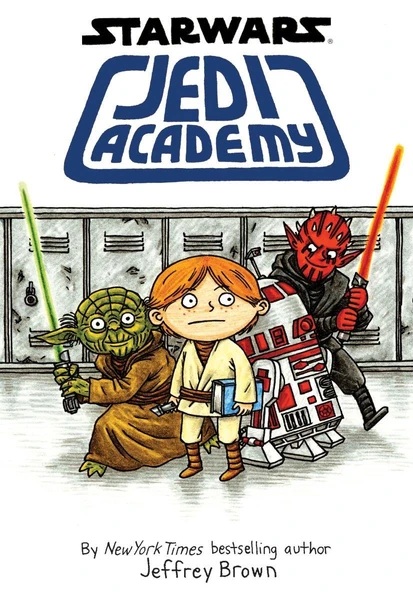
A couple of days back I grabbed Jeffrey Brown’s trio of Star Wars books for a bargain price and, after getting them delivered, went through them pretty quick. His latest is Jedi Academy, but it’s the preceding books, Darth Vader and Son and Vader’s Little Princess that really got him attention and deservedly so.

For me, it was the Jedi Academy book that showed the limits of Brown’s skills – namely, he’s great at observational cartoons that capture a single moment but this book doesn’t really work in that way, instead telling the story of a new student at the Jedi Academy, which from what I can tell, pretty much mostly resembles a US school in its structure and social interactions. This is unfortunate as it immediately limits the story in a parochial way and greatly reduces my interest in one swift stroke. Nor do I ever end up caring about the character I’m supposed to.

In contrast the Darth Vader and Son and Vader’s Little Princess books are far superior showcases for his skills. They mix observations about parenting and children with comedy riffs on all those famous one-liners from the films that we all know so well. It’s a very clever and inspired combination that’s nowhere near as easy as it looks to come up with. A lot of the best ideas are very simple but only once someone else has come up with them! All of these pieces are, on their own, excellent but it’s the overall sense of enthusiastic affection that runs through the books that raise them to another level of brilliance.
Read More