Jedi, Sith, and Force Tunnel Vision

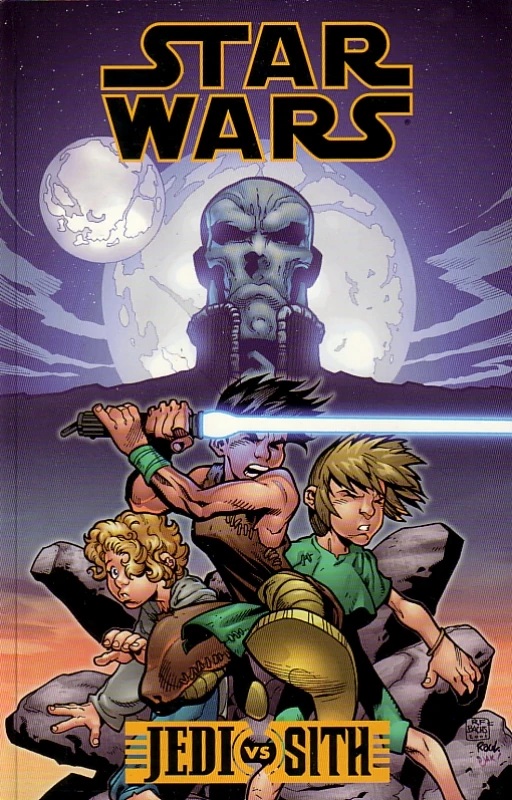
Jedi vs. Sith is a fantastic comic, but its title should not be applicable to the entire EU

No, Force Tunnel Vision isn’t a Force power you’ve never heard of. It’s the tendency that has emerged ever since the release of the prequels to focus stories on the Jedi and emphasize the Jedi-vs.-Sith conflict as the core of storytelling. This has compounded the issue of supporting cast underuse in the post-Return of the Jedi era, as the focus has become too narrow to take in much of the wider universe. In all eras it has resulted in repetitive storytelling as the Sith are trotted out again and again to fight Jedi protagonists. In this post, I will cover how the prequels transitioned Star Wars from stories that included Jedi and Sith to stories that were about Jedi and Sith, just how monotonous this has made the Star Wars universe, and how this has damaged the Star Wars universe by excluding non-Force-sensitives from the story.

The way it was

Jedi and Sith were both present in the original Star Wars trilogy. It was central to the films’ story that Luke Skywalker learned to become a Jedi Knight from Obi-Wan Kenobi and Yoda so that he could defeat the evil Force-user Emperor Palpatine and redeem his father Anakin Skywalker from life as Darth Vader, Dark Lord of the Sith. How, then, can I say that the prequel trilogy changed Star Wars’ focus? The difference is between stories that include Jedi and Sith as a component and stories that are centrally about Jedi, Sith, and the struggle between light and dark sides of the Force. The issue is the context in which the Force elements of the storyline are placed.

In the original trilogy, the conflict between Luke and Darth Vader, and later the Emperor, was vital. The introduction of the Jedi Knights and the light and dark sides of the Force were key components of Star Wars’ unique universe. The story, however, was not simply about the Jedi. Luke’s conflict with the dark side’s servants was one component of a much larger storyline concerning the war between the Rebel Alliance and the Galactic Empire; the light and dark sides were merely elements of the struggle between freedom and tyranny, good and evil in the broadest sense. Luke did not fight alone, but as part of the Rebellion, alongside the gunslinger Han, political leader Leia, scoundrel-turned-administrator-turned-Rebel Lando, and ordinary warriors like Wedge Antilles, Admiral Ackbar, and General Rieekan. He and his allies fought not only Darth Vader and the dark side, but also Forceless manifestations of tyranny like Grand Moff Tarkin, Death Stars, and stormtroopers; and Forceless agents of criminal corruption like Jabba the Hutt and Boba Fett. Jedi and Sith were one component of the bigger story, which included ordinary soldiers, political figures, and the criminal underworld.
Read More
The Rise and Fall of the Supporting Cast Post-Return of the Jedi

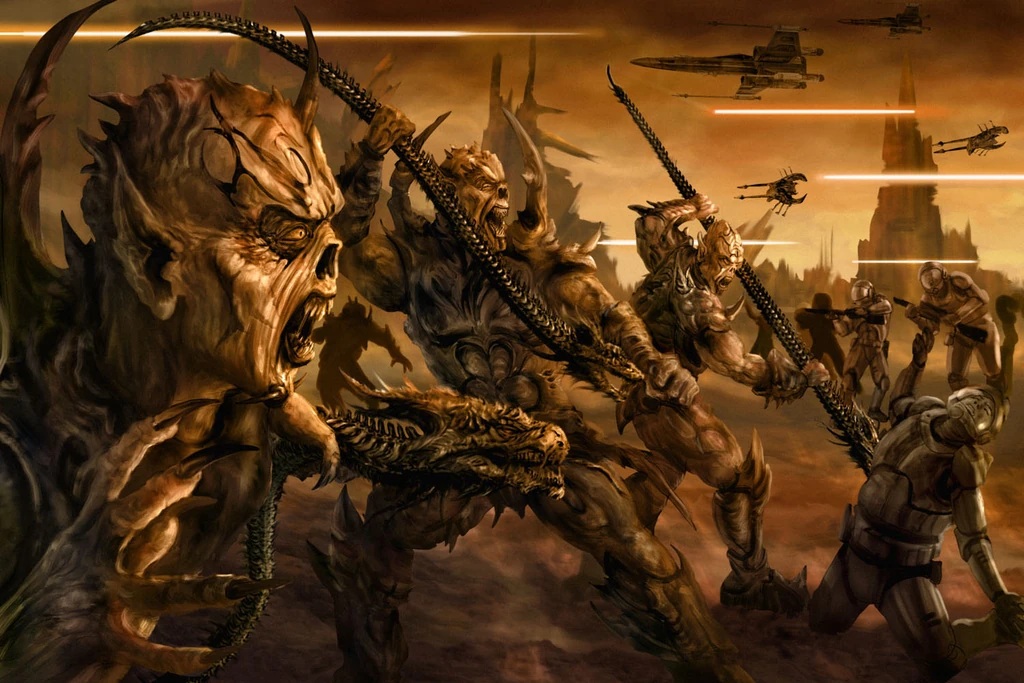
The New Jedi Order featured tons of supporting characters

One of the most distinctive features about the post-Return of the Jedi Expanded Universe is the wealth of characters who have become part of a large, unified cast supporting the small group of movie leads. This sort of cast is a fairly unique asset for a franchise, and even for an era within this particular franchise, yet in recent years it has been dismally handled. Not only have fewer members of the secondary cast been used and been used more poorly, but the focus has crept from a large cross-section of the galaxy squarely onto members of the Jedi Order. In this post, I want to address how this situation came to be and make the case for better use of the unified cast, to be followed up by a post specifically focusing on the implications of limiting stories to an emphasis on Force-sensitives.

The road to the unified cast

The initial EU did not set out to create a large-cast universe in the way of, say, A Song of Ice and Fire. This makes a certain amount of sense, as the original films had not featured a big recurring cast. They did, however, set the stage for the eventual expansion of the cast.

Aside from the villains and the core cast of Luke, Leia, Han, Chewbacca, Artoo, Threepio, and eventually Lando, the films featured almost no recurring characters. Wedge Antilles was the only supporting good guy to make it through multiple movies, much less the entire trilogy. The focus was clearly on a small band of heroes. But what the movies did have was a large-galaxy aesthetic resulting from the use of a lot of supporting characters who just didn’t recur. We didn’t get a consistent Rebel leader throughout the films, but in getting General Dodonna, General Rieekan, General Madine, Admiral Ackbar, and Mon Mothma, we got a large body of distinctive, interesting leaders who could be used and expanded on in further stories, along with the sense that the Rebellion was big and full of important people. There was a lot there for the EU to work with, and a sense that the Star Wars galaxy should have a deep bench of characters.
Read More

Politics and the Expanded Universe (Part I)

Before anyone gets too excited, we won’t be discussing the taxation of trade routes in the Outer Rim or the establishment of trade franchises in the Old Republic. Instead, we’ll be talking about the use of real world politics in Star Wars, whether by allusion or direct reference and whether to draw out certain themes or to make sociopolitical commentary. We won’t be surveying the entirety of the EU, but just specific examples that come to the author’s mind as particularly good or particularly poor ways to integrate real world politics into the fictional Star Wars narrative. If there are any striking examples you think we’ve missed or you think are worthy of discussion, please mention them in the comments

Political references have been a part of Star Wars since the very beginning, so the argument that Star Wars is purely escapism is untenable.  In 1977, A New Hope comingled references to Nazi Germany with allusions to the American Revolution.  Imperial uniforms closely resemble those of the Wehrmacht, while Imperial stormtroopers appropriated the nomenclature of the Nazi SA. By The Empire Strikes Back, it became a decided theme that Imperial officers would adopt various British accents while the Rebels would resemble plucky Yankee revolutionaries. Lucas had mentioned in interviews before the release of the Prequel films that the fall of the Old Republic and the rise of Senator Palpatine to the position of Galactic Emperor resembled the rise to power of historical dictators such as Julius Caesar, Napoleon Bonaparte, and Adolf Hitler.  Lucas drew from more than history though, because he drew themes from contemporary political events as well. The older drafts of A New Hope – the influence of which still permeates the novel ghostwritten by Alan Dean Foster – presented a weak, corrupt, and ineffectual Emperor Palpatine largely controlled by his advisors. Supposedly, this portrayal was based on President Richard Nixon, who had resigned from office earlier in the decade. Neither the films nor the novel directly allude to the former president in any real way, and though the original film channeled the political pessimism of the day towards an old-fashioned heroic romp, the only evident political allusions are to historical events decades and centuries past.

How has the EU handled real-world political references? Well, answering that question thoroughly would take more words than I have the patience to write and more words than a reader would have patience to read. More importantly, I don’t intend to just document all the political references used in the EU because I don’t think that would be very useful, and would just be cataloguing for the sake of cataloguing. Instead, I’m going to focus on only two authors and I’m going to direct my attention on how they used contemporary political references to the benefit or detriment of their story telling. I’ve deliberately picked two authors that I actually like, and those two authors are well-regarded by the fandom because I want to make it clear that it’s not a matter of good writing or bad writing: even a really good author can use politics in an ineffective way, and that’s what I’d like to show.

Read More

The End of Illusions: Part 1: Not Really Liking the Big Three All That Much!

Credit for sparking this one goes to fellow conspirator here Lisa Schap, but she’s unaware of what she started! Do I like Star Wars because of the characters of Luke, Han and Leia or is it more than that? Do I even need the big 3 as they’re called at all?

In a way the OT succeeds where the PT mostly does not in running at a pace that sweeps the audience along. The result of this is that their attention is kept at all times and they do not notice the weaknesses. Those weaknesses being the characters! I’m fascinated to see what happens after ROTJ because, at that point, the characters work for me, but why do they not before? Because Solo’s the cocky bastard type I tend to dislike on general principle despite the considerable charm Ford’s portrayal gives him. Organa is, in a lot of ways, your standard aristocratic type and a ‘for the cause!’ evangelist. Don’t really like evangelists either. And Skywalker? He’s the fish out of water and in over his head who eventually wises up, but he is a bit of whinger in the OT.

But to be fair, these are their starting points! The whole idea of a character development arc is precisely that – so where do they go and what changes? It should also be mentioned at this point the OT, to a degree, delights in throwing gender stereotypes into a blender and generously splattering them!

Leia is the one who thinks she knows all she needs to, her foil is Han who also thinks the same way – in hindsight, of course they were on collision course! Luke is the one who’s far more aware than both of what he doesn’t know and needs to, give the kid some credit – he’s a fast learner. Until writing this I had not considered Han and Leia as being opposite mirror images, but it’s an interesting picture – Han teaches Leia that she can have some things for herself, that it’s OK to not share them with the world, while Leia brings Han into accepting the fight for the galaxy. And Luke? His arc is one of ascension, to gaining the knowledge and confidence he needs to be doing what is expected of him.

Back to those gender stereotypes in the blender! By rights, Han should be insufferably cocky, Luke too incompetent and Leia too cold and arrogant an aristocrat. There’s times when that happens, but the OT ensures it’s isolated incidents, mostly within ANH. Instead it tends to invert a few things – Leia’s the one who tends to keep her emotions under control, where Luke doesn’t and nor is she content to sit back and be rescued – instead in ANH the terms of rescuer and rescued flip around frequently between the characters. Now it doesn’t seem all that big a deal but it was cutting edge for 1977. Later ROTJ fanned the flames of controversy with Leia’s treatment by Jabba, which remains a hotly contested debate topic: Was Leia badly treated in character terms or not? For me, there is the little matter that she strangles the fat bastard that says not.

By the end of the OT, they’re all in different places and I want to see where they go from here in contrast to the films where I do want to see changes because, all in all, don’t like them all that much! Then again, if the screenplays are known to have weaknesses, then it’s also known to be in the characters – oh and let’s not forget the dialogue! Sometimes you need a better pair of hands to go to work. In the shape of Good win and Williamson on their Classic Star Wars run and Perry’s Shadows of the Empire, there are two excellent works that I’m inclined to say handle the characters better than the films. They can examine them more closely and bring their out better aspects more effectively.

Of the trio, Luke is likely the one I like most because he’s less out-right cocky, but inclined to do some really stupid stuff if he but thought about what he was doing – case in point, the Battle of Yavin! Fly around a moon-sized battlestation that’s going to annihilate a planet, then go into a narrow trench and hit this one small spot? But that’s also what makes SW what it is, people doing insane things and getting away with it! Outwardly confident characters who think they know it all? Nah, just not drawn to, I need to see some flaws and them then being aware of them, if only so they can turn them to their advantage.

The Emperor and his second Death Star are toast, Vader’s dead too, what happens now? Can you really consider the story over? Why would you not want to see Leia as the politician she’s said to be? Why shouldn’t we see her build a new government to take over from the Empire? That was the point of the rebellion. Equally, the Jedi knights, how is Luke to revive that idea? And Han? Han gets to stay the smartarse he always was, but not an insufferable loner who thinks he needs no one.

Part 2 will look at where they get taken, what has worked and has not and if these characters are needed for an Expanded Universe at all!

Antagonism: The Next Generation

Should the Empire still be the primary antagonists of the Sequel Trilogy, or can the film saga move on and still remain relevant? What can we learn from the Expanded Universe about this?

Mike: While I’ve always been quick to point out how crazy it is to believe that the entire Galactic Empire just folded their cards and went home after Endor, I’m on the fence about whether they should remain the villains of a bona fide Episode VII. On the one hand, I think the New Jedi Order series is hands-down the closest the EU has come thus far to giving us a Sequel Trilogy in terms of tone, and something as wholly different as the Yuuzhan Vong would be awesome on the big screen and would go a long way toward rejuvenating what’s bound to appear to some as a tired, extraneous post-Return of the Jedi status quo, but on the other hand, George Lucas really did tie his story up in a nice little bow there.

The question, really, isn’t do the films need the Empire, it’s do the films need Palpatine? Even Lucas has admitted that if he were to have done sequels himself, Dark Empire—wherein the Emperor returns in a cloned body—came the closest to what he’d have come up with. In fact, given that Michael Arndt is ostensibly working from Lucas’ own outline, it’s entirely possible that a reborn Palpatine will indeed be what we end up with.

I don’t know if we need to go that far, but I can see the argument that the threat has to come from Palpatine in some direct way—maybe a cult of rabid non-Sith followers sowing dissent, maybe even a crazed and manipulated Jedi like Joruus C’Baoth. If the Prequels were about the Republic crumbling from within, and the Classics were about the ideals of the Republic rising anew, then the Sequels need to be about demonstrating that new Republic’s fortitude, and most importantly, showing that it—and our heroes—have learned the lessons of the Prequels and created something better, in terms of both the government and the Jedi Order. Anything that doesn’t deliberately and aggressively make that case—whether it’s more Sith, Imperial remnants, or an alien invasion—won’t truly feel like the same story. Jay, am I right?

Read More