An Autopsy for Agent of the Empire

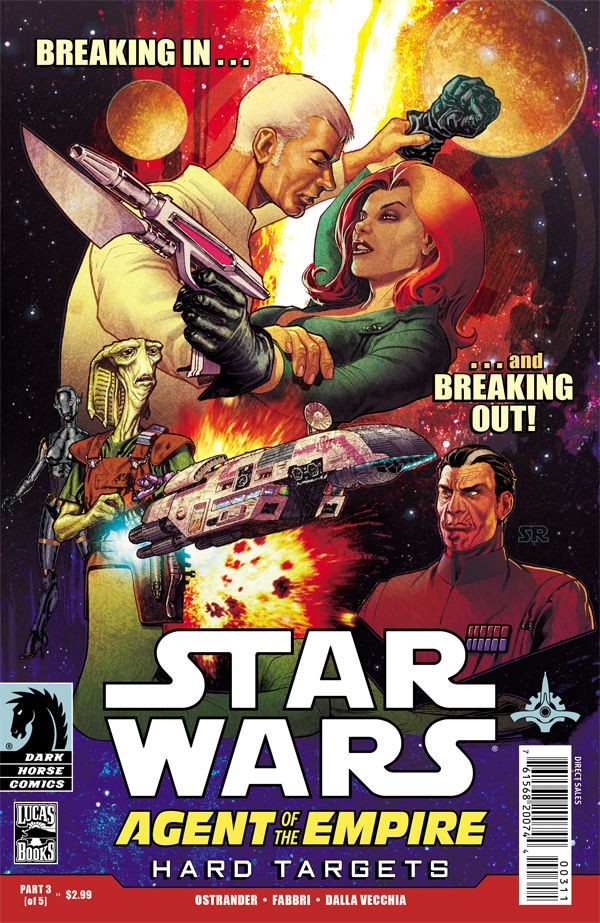
This was a truly illustrious series, cruelly cut down in its prime! That Dark Horse Comics felt unable to continue with one of the strongest creations in years is a damning indictment of the comics marketplace, but also of consumer patterns and outlooks.

What made this series so good? For me the answer is a simple one – actual moral complexity and ambiguity!  No, this was not the wearying, easy cop-out attitude of: Oh, it’s all so grey and complex, can’t decide anything.  No, this was smartly mixing up the good and evil, forcing the reader to question what they consider the terms to mean and at what level – for instance, is the good of the individual always supreme when set against that of states and worlds?

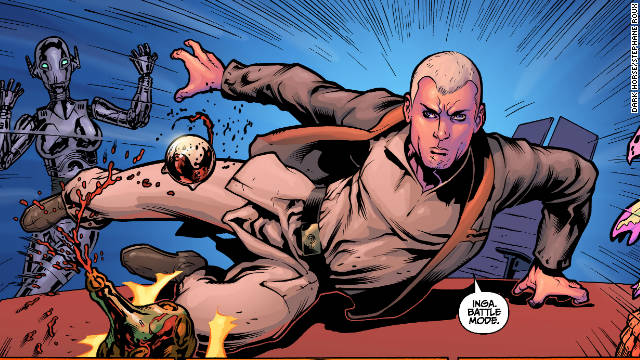
At the same time, in only its second story, it took its lead character, the coolly calculating and pragmatic, though not entirely amoral, Jahan Cross and set him on a collision course with the worst aspects of his employer.  It’s interesting to note the common attitude embodied by both Rodas Borgin, who Cross was sent to support in his attempt to become the leader of Serenno, and the Isards, towards those they consider their lesser and, as such, entirely disposable – people like Cross!

Cross’ resolution of the dilemma he ends up in is creative, smart and quite, quite convoluted.  It is a great shame that we will probably never get to see the consequences of his actions here for, though Cross believes he has constructed a perfect scheme, there really is no such thing!  This is particularly true when your boss is Armand Isard and you work alongside his terrifying daughter, Ysanne!  If anyone was going to put two and two together to get four, it would be these two.

That said there is a counter-argument that doing such would place Cross on the road to rebellion and that is a too well-trodden road.  There’s a great deal of persuasive force to this outlook.  Especially as it’s that ambiguity that makes the character work so well. Well, that along with being freed from simple heroic shackles.  It’s the same appeal that Han Solo taps, especially after shooting Greedo. (Yes, I subscribe to that side of that debate.)

So, we have smart, well-spun stories depicted in excellent art – I haven’t always been a fan of Fabbri’s art but it’s flawless for the Hard Targets arc – so what on earth went wrong?

Part of the story is in the cost of comics relative to other entertainment options.  For instance you can likely buy a hardback book for the cost of a standard-size comic collection, termed TPB, or a DVD series or even a Blu-Ray disc! This is what comics are up against.  At the same time the greater sales and different economies of scale mean these rival options can be cheaper while offering more!  Books? Only have to pay for author, agent, publisher, printing.  Movies? They are not cheap but if you know it will sell enough, the price can be adjusted accordingly.  In contrast comics have the writer, artist, inker, colourist, editor and printing – far more to pay for and a much smaller consumer base.  And then there’s the price of comics, now regularly $3-4 per issue!  If you are to spend $15-20 on 5 comics or a TPB, it has to be worth it.

Then there is the strange perception, which began on superhero stories, that if a story has no immediate impact on continuity it does not count!  Might this have played a part in Agent of the Empire’s fall? Certainly.  It’s set 3 years before A New Hope, the Empire is on top and it’s staying there.

Might the lower profile and social perception of comics played a role?  Highly likely.  Comics are still, despite the success of graphic novels and films based on comics, seen as a lesser narrative option.  While people have no objection to audio-visual entertainment, there’s a strangely dismissive attitude to comics: Word and pictures, isn’t that for kids?

Yet, even if those were all overcome would it have succeeded? If there had been a big marketing campaign, perhaps playing on the Bond element, would it have done better? Hard to say, not least as the Bond tag is a double-edged one.  It would attract some but repulse others, if only on the basis: Star Wars does James Bond, what’s so special about that?

So, what would be my final conclusion as to the cause of death? I would place it to be a combination of low sales and consumer neglect.  Clearly, there is but one remedy – tell other people to buy the collections.  Obviously volume 1 didn’t sell that well either, but first stories are tricky.  Agent of the Empire improved immensely in its second volume, but lo! The axe had already fallen!  But, what if both volumes were to sell well? Who knows? Perhaps a resurrection might be on the cards.

Forbidden Knowledge: Question Everything Except the Force

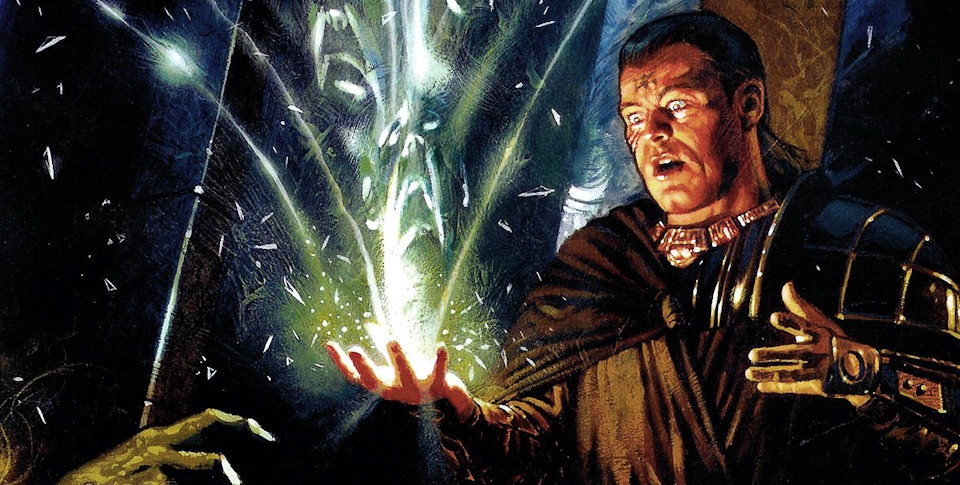
Exarkunsithholocron

“There is no ignorance, there is knowledge.” — Jedi Code

But knowledge of what?  The cosmetic difference between Sith and Jedi, and between the Light and Dark sides of the Force, is emotional – are we raging or are we at peace?  Those emotional states are held to be so important because they are said to be conducive to broader goals – namely enforcing one’s will on the Force, or accepting the will of the Force.

The Sith seek power while the Jedi seek serenity, and considering the popularized Buddhist philosophies that influenced Lucas during their creation, it would seem reasonable to wonder if the Jedi focus on knowledge refers to self-knowledge.  Accepting this, however, requires a less than fundamentalist approach to our opening aphorism, and leaves us wondering about the scope of their attitudes to knowledge of other types. Is forbidden knowledge a feature of the Jedi worldview?  Is it troubling if it is?

“Knowledge is power.  Power corrupts.  Study hard.  Be evil.” — Anon.

The Sith seek power at any cost, and have always been portrayed as pursuing it academically as well as physically and spiritually.  Their mysticism is full of ancient texts, rituals, alchemies, biological experimentation and even history and record-keeping.  Contrast this with Jedi training that focuses far more on instinct, on reacting as an extension of the Force and its will, without the need for conscious thought, and the Jedi view of knowledge seems far more focused on transcendental intuition than on any externally verifiable framework.

“You must unlearn what you have learned.” — Yoda

If there is no ignorance because the Force provides all knowledge that is needed, that would indeed account for the large number of Jedi derailed by the dark, corrupting Sith temptations throughout the millennia. But this also makes the element of religious faith in a higher power – albeit one that is not actively sentient in the traditional manner of Gods – much less avoidable.  I don’t think that’s at odds with the notion of the Jedi as a monastic order, or with the way they’re portrayed in most Star Wars media, but I do think it’s something we’re not necessarily honest about.

Therefore, if I may present an emblematic case study: the Solo twins.
Read More

John Jackson Miller on Iron Man, Kenobi, and Matters of Scale

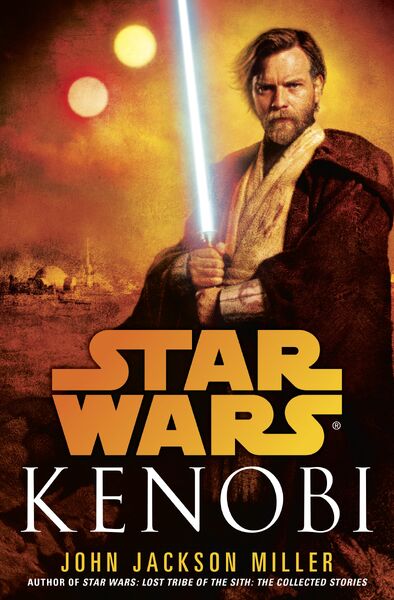
Star Wars is no stranger to “genre” storytelling, and John Jackson Miller’s Kenobi, coming out on August 27, is just the latest example. Originally conceived as a graphic novel, and borne from a friendly challenge to Miller to write an honest-to-goodness Star Wars western, Kenobi tells of Obi-Wan’s earliest days in exile on Tatooine, and crucially, his first interactions with the locals despite his best efforts to remain, well, safely anonymous.

While most familiar to Star Wars fans for his long-running Knights of the Old Republic comic series, Kenobi is only Miller’s second prose novel (third if you count Overdraft: The Orion Offensive, which was serialized at Amazon.com over the summer and is now available as a collection in both print and eBook formats). Recently he was gracious enough to answer a few of our questions on both Kenobi and his earlier exploits.


Eleven-ThirtyEight: Let’s start at the beginning: your first Star Wars work was a one-shot Darth Vader story in the comic series Star Wars: Empire. While I was vaguely aware that your previous work was a run on Iron Man, I’m ashamed to admit I had never put it together before now that yours was the old “Defense Secretary Tony Stark” story. Can you talk a little about the creative through line from Iron Man to Star Wars? You took some time off from comics between the two; what then prompted you to pursue Star Wars in particular? Any interesting pitches that didn’t make the cut?

John Jackson Miller: Iron Man had come about because of my work on the Crimson Dynamo series for Marvel’s Epic line in 2003, and it really was a marathon — we were biweekly for the last seven issues of the run to bring things to the point where “Avengers Disassembled” began, and it was a test of endurance. And rather than taking time off, I spent the months immediately following that redesigning Comics Buyer’s Guide from a weekly newspaper into a monthly magazine, and that was time-consuming. It was really after San Diego in 2004 that I began pitching again, which led to work on the Simpsons line and the Empire gig.
Read More

Beware of Tionese Bearing Gifts: A Long Time Ago, Part 2

Who are the Tionese?Lost_Legacy_Cover

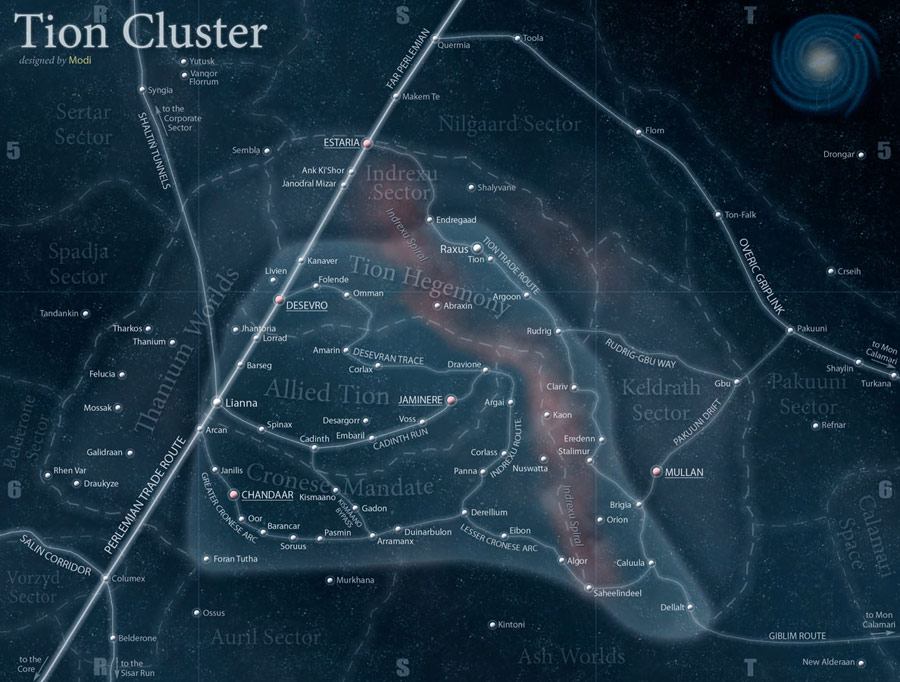
An ancient human culture, the Tionese first appeared indirectly in Brian Daley’s Han Solo and the Lost Legacy. The Tionese inhabit the Tion Cluster, in the Outer Rim just north of Mon Calamari Space. Aside from mentions in Geonosis and the Outer Rim Worlds and The New Essential Chronology, the Tionese were mostly forgotten by the EU at large until 2009, with the publication of the Essential Atlas. The Atlas greatly expanded on Tionese history, particularly the conquests of Xim. Further work was done on the Tionese during “Xim Week”- particularly Jason Fry’s The History of Xim and the Tion Cluster– and John Hazlett’s  The Written Word.

It’s All Tionese to Me
Shuttles_img

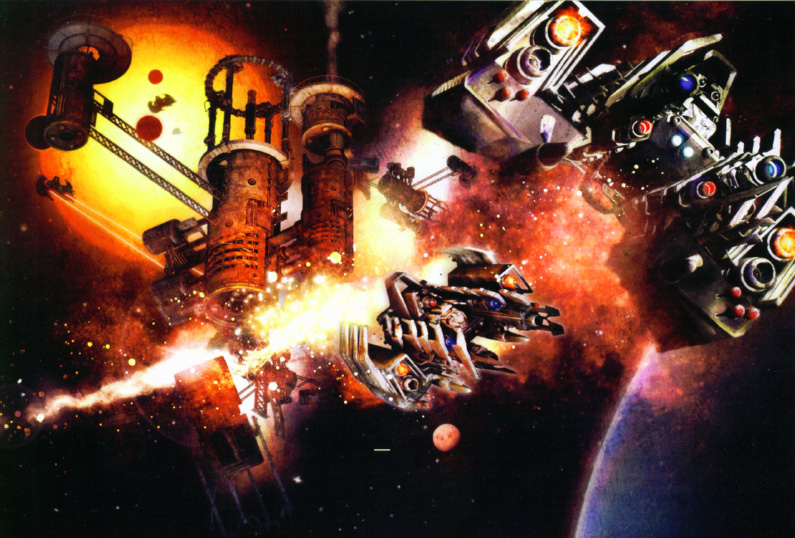
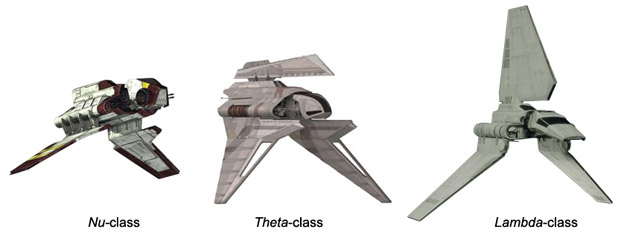
Much like the Latin Alphabet, the Greek Alphabet has been canonized within the GFFA, this time as the written language of the Tionese. According to The Written Word, the Tionese language was devised as an administrative tool by Jansari (A powerful group within the Livien League of the northwestern Tion Cluster). While it has been largely superseded by Aurebesh (and to a lesser extent in recent times, by High Galactic), the Tionese language remains in use in the Tion Cluster- most notably by several starship companies. Cygnus Starworks (Cygnus, the Latin word for ‘swan’, comes from the Greek ‘cycnus’, which refers to several characters in Greek mythology who were transformed into swans) produced various spacecraft in cooperation with the famous Sienar Fleet Systems for the Galactic Republic and Galactic Empire- spacecraft whose designations rather conspicuously utilize Greek letters, such as the Lambda-class shuttle piloted by Han Solo in Return of the Jedi, or the Theta-class shuttle which Palpatine utilized as a hyperspace-capable ambulance in Revenge of the Sith. Sienar Fleet Systems was headquartered on Lianna in the Tion Cluster, while Cygnus Starworks was based in the nearby Cygnus Star Empire. The Tionese alphabet was also utilized by various militaries in the GFFA—Delta and Omega Squads from the Republic Commando series bear such designations, and Luke Skywalker orders Rogue Squadron to adopt Attack Pattern Delta during the Battle of Hoth.

A Divided Tion
ximcluster_smAthensempire

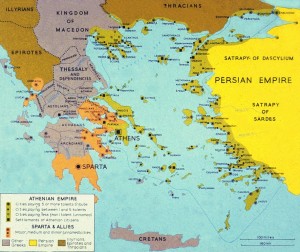
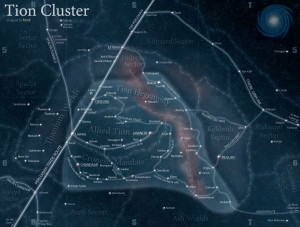
After the decline of the Rakata, the human culture that came to inhabit the Tion Cluster repurposed old Rakatan technology to develop the hyperdrive independently of the Republic. The Tionese formed a cacophony of independent states within the Tion Cluster, constantly warring and allying with each other without any one faction gaining dominance over the rest. While the Tionese shared elements of a unified culture, the Tionese did not unify into one state of their own. Multiple alliances existed between independent Tionese states- the Livien League, the Kingdom of Cron, the Ihala Spiral, and the Three Allied Kingdoms. The political state of the Tion pre-Xim greatly resembles classical Greece. While all sorts of intercity alliances were formed (such as the Delian League and the Peloponnesian League), and some states even gained the upper hand in a region for a time (for example, Athens gaining control over much of the Aegean), no one Greek city-state gained complete control over Hellas.

Xim the Despot: Alexander’s Less-Successful Fanboy
megas alexandros

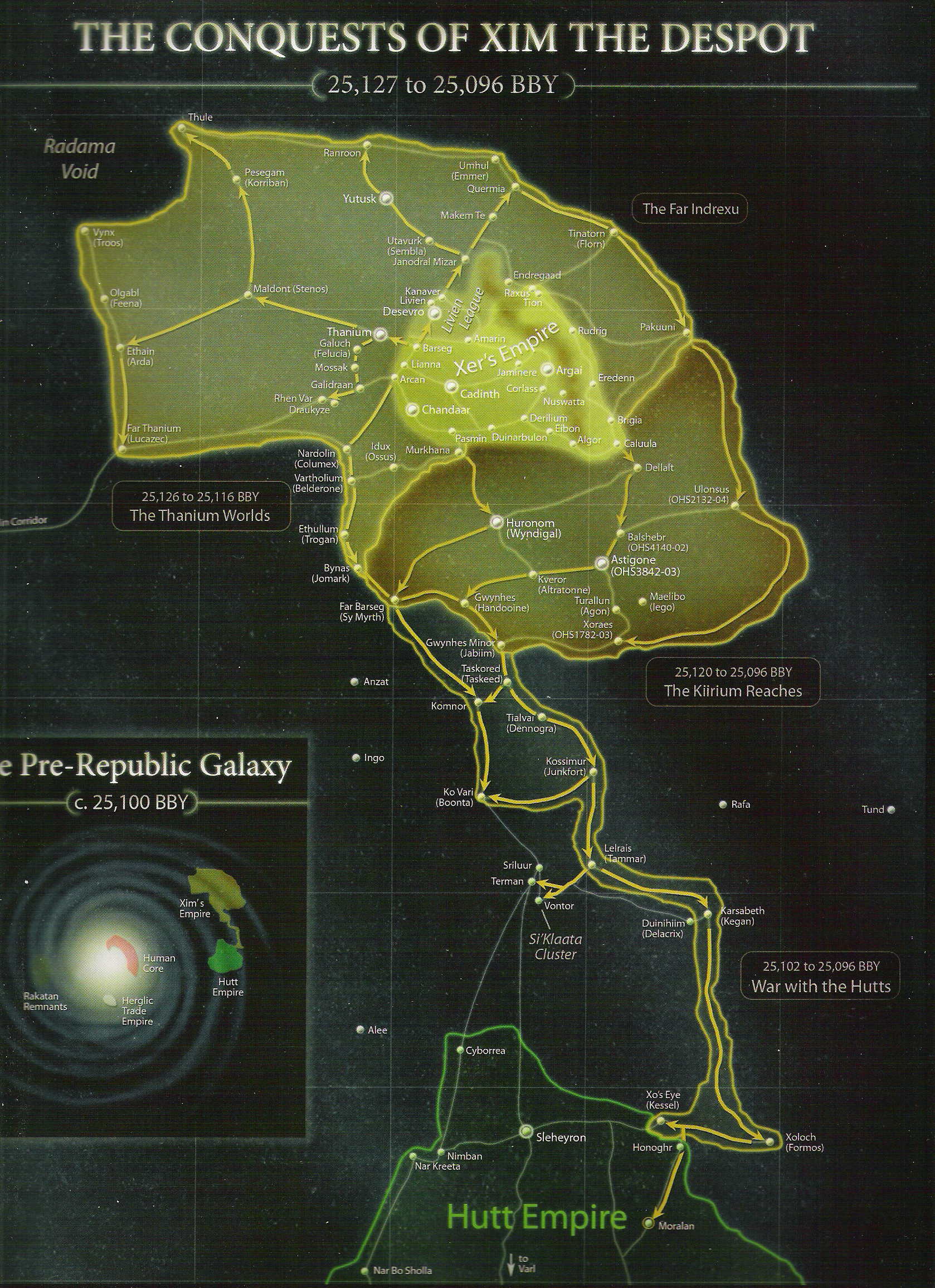
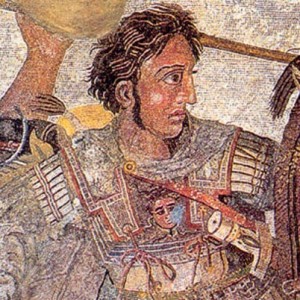
First mentioned in the 1979 Han Solo and the Lost Legacy, Xim languished in the dustbin of the EU until the mid-2000s, when the New Essential Chronology and Xim Week greatly expanded upon his career. As a result, Xim the Despot has come to resemble a less successful Alexander the Great. Xim’s career owed much to the exploits of his father, Xer VII, whose conquests in the northern Tion provided a base of power from which Xim could conduct his raids and subjugations throughout the Tion. Xer conquered much of the Tion Cluster proper, and upon his death was succeeded by Xim, who finished what Xer had started and expanded beyond the borders of the Cluster. At its height, Xim’s Empire extended from the Radama Void to Kessel, and attempted to push into the Hutt Empire, that early bogeyman of humankind in the GFFA. Xim’s diplomacy and tactics were ruthless, yet he met his match in the form of the Hutts, led by Kossak the Great. After a series of three ritual battles over Vontor, Xim was thoroughly defeated by Kossak; accounts differ as to whether he died at Vontor or rotted in Kossak’s dungeons. Xim is described in some sources as egotistic, even megalomaniacal, with his vision of a large empire outstripping the practicalities that the resources at hand lent him. Xim picXim’s career resembles that of Alexander, had Alexander been crushed repeatedly at the Battle of Issus by Darius III of Persia. Like Alexander before him, Xim owed his initial powerbase to his father, who died under suspicious circumstances—regardless of whether or not Alexander’s mother actually poisoned Philip II, the rumors surfaced nonetheless, and no doubt helped to inspire Xim’s mother/wife, Queen Indrexu. Both Alexander and Xim, after unifying their normally fractious cultures (who in fact regarded them initially as barbarian foreigners), made war upon their cultural bogeymen, be they the Hutts or the Persians. Xim’s story differs in the conclusion—Alexander crushes the Persians and goes on to carve out a massive empire, while Xim’s momentum comes to a wrenching halt in orbit above Vontor. The empires formed by both figures fell apart upon their deaths- Xim’s conquests were gobbled up by the Hutts or simply broke off from his Tionese Empire, while Alexander’s generals (often called the Diadochi) scrambled to carve out the corners of his empire as their own personal kingdoms.
War with the Republic, Galactic and Roman

After the fall of Xim, the Tion Hegemony returned to its previous fractious state. Xim’s outlying conquests were conquered, declared independence, isolated, or sterilized by the Hutts. Circa 24000 BBY, scouts from the Tion encountered traders from the fledgling Republic- among whose member cultures several regarded the Tionese as their cultural antecedents. Sensing an opportunity to expand, the Tionese formed the Honorable Union of Desevro and Tion and invaded the nascent Republic along the Perlemian Trade Route, Tionese_Raidersfission-bombing multiple Republic colonies. While the war initially went in favor of the Tionese, the Republic rallied, constructing its first real navy and enlisting the aid of the Jedi Order. The Republic then took the war to the Tion Cluster, devastating multiple worlds and bombarding Desevro. The Tionese War resembles the Macedonian Wars, conducted from 190-146 BCE by the Roman Republic against the Antigonids, rulers of Macedonia. Like the Republic—particularly the planet Alsakan– the Romans viewed the Greeks as their cultural forbearers, even as they went to war with them (the Roman Republic pushed the narrative that they were ‘liberating’ the Greeks from the ‘tyranny’ of the Antigonids). The onus for starting the war differs- the Tionese outright invaded Republic Space, whereas the Romans engineered a cause for war in order to invade Greece. As I mentioned in “Senatus Populusque Res Publica Galactica”, the devastation of Desevro at the end of the war echoes the sack of Corinth at the end of the Third Macedonian War- a war fought against a recently-formed league of Greek States meant to drive the Romans from Greece. Like the Tionese, the Greek were incorporated into the Roman Republic after the Macedonian Wars, as the provinces of Macedonia, Graecia, Thracia, and Achaea.
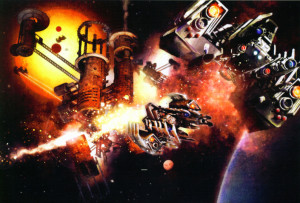
Decline post-Tionese Wars
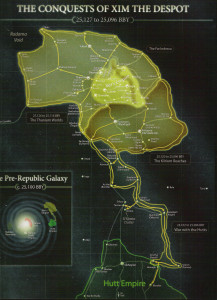
xim empire

Following the defeat of Xim, the Hutt expansion into former Xim-controlled territories, and the Republic conquest of the Tion Hegemony, the Tion gradually became a backwater on the Outer Rim. The momentum of expansion fell to the Republic, and that expansion for the most part was directed away from the Tionese, into the Slice and the Northern Territories. The Tion Cluster did experience a brief resurgence during the Clone Wars. Count Dooku announced the formation of the Separatist movement from the surface of Raxus Prime, and the Tion supported the CIS during the Clone Wars, even hosting the Separatist Council for a time on Raxus. After the war, the Empire further divided the Tion into several sectors in order to prevent the formation of any potential power blocs in the region. They need not have worried, as by this point in time the glories of the Tion lay far in the distant past. Xim and the Tion describes the worlds of the Tion circa-GCW as almost uniformly backwater worlds who cling to notions of past glory while being home to little more than subsistence farmers and tourist attractions- the Tion has become the statue of Ozymandias in the eponymous poem. Like the Tion Cluster, Greece and Macedonia were divided into several provinces by the Roman Empire. After the death of Alexander, the momentum of expansion in the Mediterranean and Mesopotamia shifted away from Greece itself. In the East, the Seleucid Empire (founded by one of Alexander’s generals and encompassing much of the old Persian Empire’s territory) and the rest of Alexander’s successor states fought over the remnants of his empire, while the Antigonids of Greece tried their best to simply hold onto Greece. In the Mediterranean, Rome’s star waxed as Greek power waned- first with the Romans taking the Greek colonies in southern Italy and Sicily, and then with the Macedonian Wars. While it didn’t exactly suffer under the Roman Empire, and indeed the Eastern Roman Empire later used Greece as its base of power, the Hellenes cannot be described as the masters of the Mediterranean during the era of Roman dominance.

Tune in next time, as Tyler explores the Vikings, the Mongols, and the Celts, and how they all exerted an influence upon those lovable, overrated psychopathic mercenaries, the Mandalorians.
The Clone Wars: 2002-2005 – Looking Back at a Unique Experience

With Episode II: Attack of the Clones released and the much mentioned but little known about Clone Wars begun, the summer of 2002 saw the start of a unique piece of the EU. But in order to recognize just how revolutionary this was, we need to look at what had gone before. Previous bridge stories had been done but only in very limited fashion – The Approaching Storm gave little away of what Episode II would be about, while Splinter of the Mind’s Eye betrays a pre-Empire Strikes Back origin.

No, the best bridge stories up until this point were done retroactively, after the film had come out then there were stories filling in the gaps. Thus for Episode I there are the Darth Maul stories and Cloak of Deception. More significantly, the much praised Classic Star Wars run by the great team of Archie Goodwin and Al Williamson bridged Episodes IV and V, but ran 1982-1984! It could take full advantage of knowing what pieces needed to be set for Episode V to begin! The 1996 Shadows of the Empire project operated on similar grounds.

What Lucasfilm (LFL) seemed to realize is that they had a unique opportunity here, to tell the stories of the Clone Wars, to greatly expand and show the full scale of this vast galactic conflict. A twin track strategy was deployed – Del Rey (DR) would do a series of books, each focusing on particular aspects of the conflict, while Dark Horse Comics (DHC) would spin their own ongoing tale.

Of the two, I would judge DHC to have been the more successful. This is due to the two stories it told – one continued the story of Quinlan Vos, ultimately concluding it post-Episode III, while the other was on Obi-Wan Kenobi and Anakin Skywalker. The latter was of particular importance given the disastrous portrait that was established by Episode II. The tragedy of Anakin Skywalker only works if the audience has reason to care and want him to do well – in both respects Episode II failed completely for me. Where the film failed, however, the Expanded Universe would succeed.

At the same time what has since come to be known as the Vos epic took the character deep into dark territory as he attempts to do an inside job on Dooku’s operations. This evoked the likes of Dark Empire but it took advantage of the far greater space to spin a deeper tale. It looked far more closely at how a person like Dooku would work, what he would require of his minions and then showed why that was so perilous for a Jedi. In doing this it also drew fully on all manner of EU lore, with the planet Korriban making an appearance and dark-side creatures featuring.

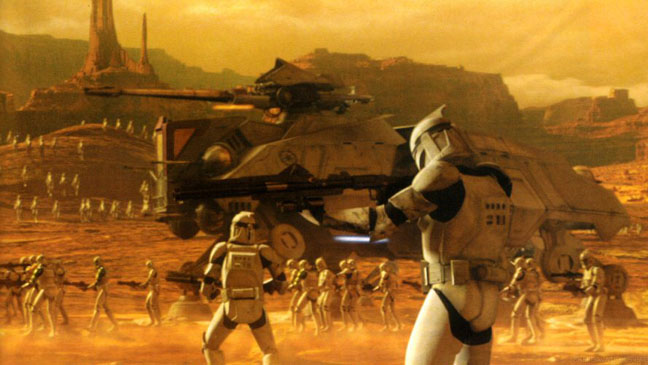
DHC adopted a split focus; their Republic title would do a story of Anakin and Obi-Wan, then one on Vos, then something else, just to add variety – like the story of what happened to ex-Chancellor Valorum. There was one final, additional strand running through the entire set of stories and that was the corrupting effect of the conflict. That it was being used, in part, to kill Jedi but there was more to it. The greater part of the design was to subtly shift the galaxy towards a more martial, more militaristic, more imperial mindset. For instance, one early highpoint saw the Republic using AT-ATs!

DR’s books took more of a scattergun approach: Stover’s Shatterpoint was highly praised – for myself, it took the notion of being as brutally honest as possible about war while still being an entertaining read. In terms of showing the brutality of war, it still only likely scratched the surface but it went far enough to make the point that some pools are not to be dived into! The Cestus Deception was an interesting but not too successful attempt to breathe life into the clones. Jedi Trial was to be the story of how Anakin Skywalker becomes a Jedi Knight, but many saw it as more military manual than story. The Medstar books were a success, but then riffing on M*A*S*H in a SW setting was a great starting point. They were also a neat continuation by stealth of a couple of characters previously established by Michael Reaves.

Following this initial set, there were a few further works done, some bearing the A Novel of the Clone Wars tag, some not. One was Republic Commando: Hard Contact by Karen Traviss, a book that remains her best work by far. More significant still was Yoda: Dark Rendezvous, a tale of Dooku and Yoda with each trying to convert the other to their way of thinking. Alongside Shatterpoint, Dark Rendezvous consistently tops lists for best Clone Wars book. In a way it’s fitting as Shatterpoint was first and Yoda: Dark Rendezvous the last. The next book was a lead-in to Episode III, Labyrinth of Evil and it built further on the continuity the Clone Wars stories had built.

As DR brought their set of stories to a close with an eye on Episode III, so too did DHC. Vos’ infiltration, subsequent corruption and return formed the main spine of the overall tale, which culminated in a major battle on an outer rim planet. These Outer Rim Sieges continued into Episode III and were a major part of Darth Sidious’ plan to spread out and isolate the Jedi, so as to enable their killing to be much easier.

And then, in 2007, it was decided to re-set the Clone Wars, to tell the story again! In doing so, much of what was done here effectively got steam-rollered! But, far more importantly, is what this shows about the corporate mindset. The corporate mind is blind to things being unique, to things being one-off, to things being unrepeatable!

And Clone Wars 2002-2005 was all of this! We got a continuing story from one film to the next across 3 years! The whole time it was new territory, it had this mythic sense of momentum to it, that this would take us all the way into Episode III. While that film did what it could to show Anakin Skywalker’s better aspects, it was still a botch job. The real reason Episode III had an edge to it for me? Because I’d been reading the Clone Wars work, because I had a greatly expanded portrait of the friendship between Anakin and Obi-Wan – watching that fall apart was sad. Equally sad was the sheer blatant artifice of it too.

Reading it was quite, quite superb and it’s not going to happen again, not like that. Part of the fun was the surprise factor, that a project of such ambition was sprung on the fans out of the blue. I’m sure there’ll be attempts to re-engineer this, but like the attempts to re-create a character like Boba Fett, it’ll fail. Why? Because you only get to catch lightning in a bottle rarely. The years since have only emphasized this sense, only increased the sense of having seen something special. At the time it felt like this would be a real one-off and so it has proven.