Let’s face it and bring it out into the open now. History is going to repeat itself and Episode VII is going to bring us the death of Luke Skywalker. Shall we review? In Episode IVwe see the death of the Force-using mentor to the protagonist (Ben’s death to Luke as the hero). In Episode I we also have the death of the Force-using mentor to the supposed hero or heroes (Qui-Gon Jinn to Obi-Wan and Anakin as the heroes). This is a classic move that enables the up and coming hero to actually become the hero. In each instance the Force-using mentor died at the hands of a Sith opponent and if you read the roundtable discussion on who we think the antagonists for the ST will be we pretty much agreed that a Star Wars movie is not a Star Wars movie without the clash of the red lightsaber with a variety of different colored lightsabers.
I see no reason why Episode VII won’t follow along the same lines to begin the hard journey for the next set of Jedi. If we toss out the Expanded Universe and for those that do read it we realize that the majority of fans out there are movie fans then Luke Skywalker is the only Force user (technically we’ve never seen Leia use the Force) and it makes the most sense for the mentor death to be him. From a shock value standpoint it would also be the biggest shock to the viewers. I remember how I felt when Obi-Wan Kenobi “died”. Hearing his voice tell Luke to run did little to console me while watching the movie for the first time.
In order for the death of Luke Skywalker to be a viable option for Episode VII the creators need to be ready with a likeable, believable second mentor to fill the hole caused by the death of Luke Skywalker. This would actually be a good fit for several Expanded Universe characters to be included or even a child of Han and Leia (provided that the movies go along with them being together still). Luke was able to keep training because he was told to go to Dagobah where he found Yoda. Anakin was able to train because Obi-Wan Kenobi was there to step into the mentor role. The next generation of Jedi is going to be no different.
They’ll need the freedom to get into their own sorts of trouble and I firmly believe one of the failings of the Expanded Universe in developing new Jedi is that Luke Skywalker is always there looming over the characters and it is difficult to believe, in universe, that the most powerful man in the galaxy wouldn’t go deal with the problem himself. I don’t want to see the OT all over again, I want to see new characters and I believe in order to get that Skywalker has got to go. With the rumored time jump for Episode VII and the previous history of using older adult Jedi in the Clone Wars and the Prequels there needs to be a good reason for Luke to not be the one out saving the galaxy. Mark Hamill himself said he would like to play an “Obi-Wan type of role”. In the EU we make jokes that started with 60 is the new 40 and continued on with 80 is the new 40. I don’t want to see the ST make the same mistakes as the EU and attempt to think this will be believable for the fans. Or even that this is what the fans want. This isn’t what the fans want, right?
What better way for the new antagonists to be taken as a serious threat than to off the Jedi who took down Darth Vader and the Emperor? I am having a hard time believing they are going to be able to create a villain that I will hate as much or more than the Emperor. However, if they had said villain take out Luke that would probably do it for me. I need that. I need to hate the villains in the movies. I love that part about books and movies. I’m pretty sure the reason I still don’t like the Empire is because of the burned bodies of Uncle Owen and Aunt Beru. Star Wars is violent. Wars bring death and destruction. I expect nothing less from Episode VII.
Disney is excited about the Star Wars franchise and they are already hinting that these movies are going to spawn side movies. They need to have young, intriguing and compelling characters to further the franchise with. We need to move past the Big 3 and I believe this will start with the death of Luke.
The issue of gender representation in science-fiction generally, and in Star Wars specifically, can be a greatly contentious one, with continued debate ongoing. Such debates tend to focus on specific works, characters, or situations, which is all valuable, but it may prove useful to also look at the picture in a very broad sense. Equally useful is to look at the gender breakdowns of certain species within the Star Wars universe, to see if there are different patterns, or how gender representation may vary across that demographic boundary.
The Big Picture
Wookieepedia identifies individuals by gender, which makes this sort of comparison possible. The Category: Individuals_by_Gender page is therefore the start point for this analysis. A current sample [1]Aug 3, 2013 yields 22486 individuals with gender status. They can be broken down by gender as follows:
Table 1: Individuals by Gender (All-species)
Gender
# of Individuals
Male
16311
Female
4585
Hermaphrodite
202
Unidentified
1388
Total
22486
These results are extremely clear: the Star Wars universe is unequivocally male-dominated, with a male-to-female ratio of roughly 3.5:1 rather than the 1:1 we would expect in nature. The number of hermaphroditic individuals is extremely small compared to the whole and composed almost entirely of Hutts. The number of individuals of unidentified gender is actually rather small. It is considerably less than the proportion of individuals of unidentified species. I hypothesize that the revelatory power of gendered pronouns in non-visual media is likely responsible for that discrepancy. Read More
Welcome to Escape Pod, a new series here on Eleven-ThirtyEight, wherein a staff member picks one character or element from the Expanded Universe—independent of existing stories featuring said element—that they feel is vital to the Galaxy Far, Far Away and should survive a hypothetical continuity reboot. Rather than focus on the Sequel Trilogy specifically, the goal of Escape Pod is to detail the subject’s inherent value to the Star Wars setting itself.
Bothans occupy an interesting position in Star Wars continuity. Despite dating back to the Original Trilogy, they’re one of the last things the OT added to the galaxy before its completion—and as far as George Lucas is concerned, they never came up again.
As it happens, it’s not even clear from the dialogue in Return of the Jedi that they are in fact an alien species. Speaking for myself, I remain unconvinced to this day that in Lucas’ mind, “Bothan” isn’t just some special GFFA spy title—he certainly had plenty of opportunities to demonstrate otherwise, but between six hours of prequel films and over 100 episodes of The Clone Wars, he never felt the need.
Luckily, the EU has taken the most meager of balls and run very, very far with it.
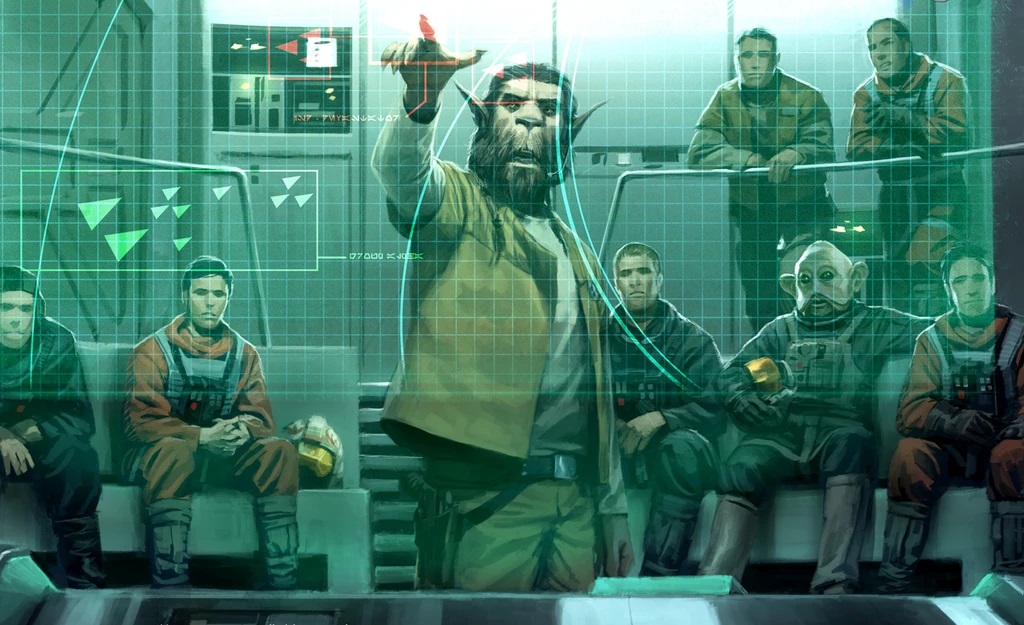
By sheer coincidence, just this morning I happened to read the first instance of the word “Bothan” outside of RotJ in issue #80 of the Marvel Star Wars comics; alas, once that brief tie-in to RotJ was out of the way it looks like Marvel didn’t have anything to add on the subject either. Enter Timothy Zahn. In 1991 Heir to the Empire unveiled Borsk Fey’lya, one of the earliest members of the Rebel Alliance, pillar of the New Republic government, and perhaps most interestingly, gigantic douche. Fey’lya added new depth to the “ambiguous bad guy” role invented by Boba Fett by undermining the heroes at every turn—including getting Admiral Ackbar arrested—while simultaneously being a figure of great significance to the Rebel cause and, frankly, not a totally-unreasonable dude.
I think the true genius of Zahn’s interpretation of the Bothan species is that he circumvented one of Star Wars’ hoariest tropes—OT character x has this job, therefore their entire species has that job—while still rationally extrapolating from what little info the films had given us. The Bothans were famous for their Spynet, sure, but that was basically an outgrowth of their true love: politics.
The Bothans rejected the Empire because when your business is politics, tyranny is bad for business. For his part, Borsk Fey’lya wasn’t really a dishonorable being; his actions came from a cultural understanding of chicanery that seems dickish to humans, but at his core he only wanted what was best for Bothan Space, and therefore, the New Republic.
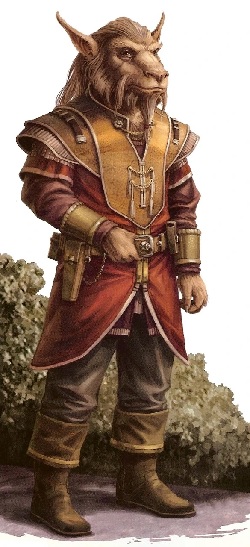
That kind of moral complexity can be hard to find in Star Wars; it’s all over the place if you know where to look, but more often than not it’s well below a surface littered with guys in white hats and black helmets. By their very existence, and complicated status as protagonists, the Bothans are the perfect species to represent the Rebel Alliance in the popular imagination—as an organization that pulls together all sorts of divergent beings and ideologies, and is too often portrayed as only marginally less homogeneous than the Empire. And did I mention they’re crazy-looking horse-dogs?
Which brings me to my next point: the aesthetic value of Bothans. Another all-too-common trope in Star Wars is alien species that look like rejected Ninja Turtles characters—cat people, spider people, killer whale people (okay, that one is kind of awesome), and so on. Bothans are that rare breed (heh) of alien species that feel familiar, or at least plausible, without being a real animal hastily stapled onto an anthropomorphic frame. It’s actually become a bit of a running joke in EU fandom that two different prose descriptions of a Bothan can give rise to two totally different interpretations.
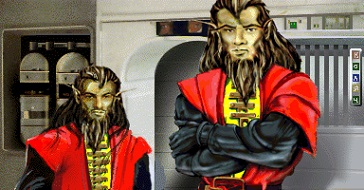
The plus side of this relative inconsistency is that if some seven-figure screenwriter felt like putting Bothans in a movie down the line, they’d have a fair bit of leeway to tweak the design to their tastes; after all, even a slavishly EU-faithful movie Bothan wouldn’t match all the existing imagery.
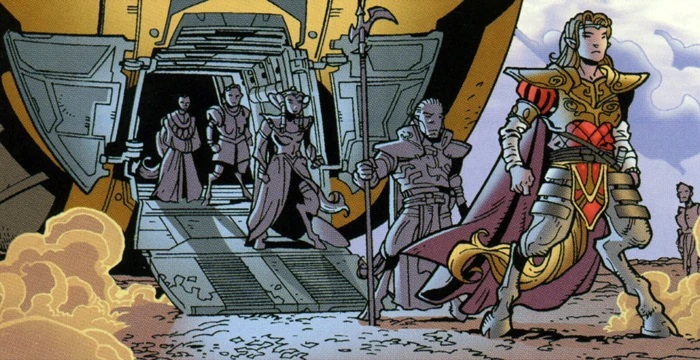
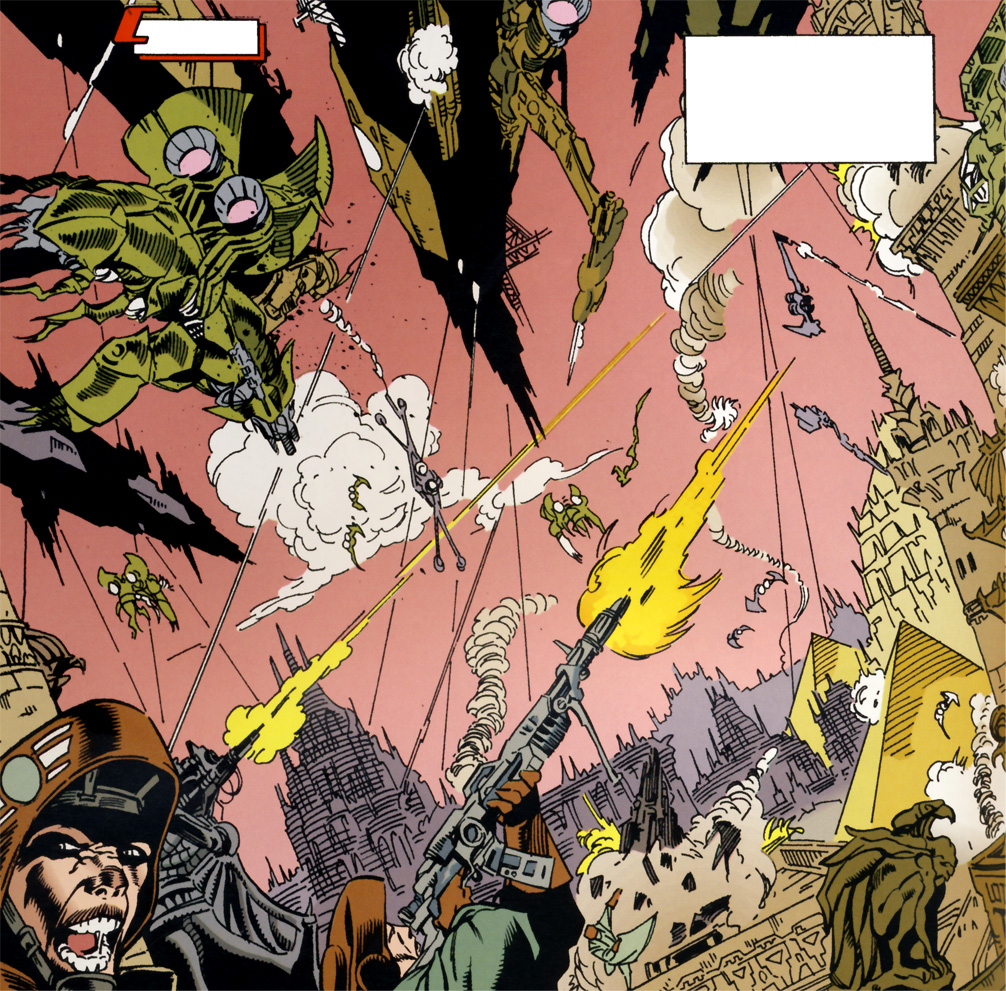
And speaking of which, my final point is one that even I don’t fully understand: in a galaxy dominated by humans, the Bothans, for whatever reason, have been consistently portrayed as one of the alien species most likely, and most willing (on both sides) to couple with humans. Well, part of that I do understand—one of those aforementioned lazy alien designs that comes up every so often is basically Puck, the half-goat faun character from A Midsummer Night’s Dream. Despite Bothans not having horns, well, ever, the EU has retconned a whole half-human, half-Bothan species into existence purely to explain the presence of things like this:
Furthermore, even in the far-less-flighty “modern” era of the films, regular Bothans have been depicted on more than one occasion to be romantically involved with humans. First in Requiem for a Rogue, as a brief fling for Rogue Squadron pilots Hobbie and Janson (movie characters, no less!) that notably comes and goes without anyone in the story so much as raising an eyebrow, then later in the Rogue Squadron novels as the really-quite-poignant relationship between Biggs Darklighter’s cousin Gavin and Bothan agent Asyr Sei’lar. Even better, the star-crossed lovers—literally!—end their relationship due to Bothan prejudice against humans, not the other way around, once again nicely subverting the expected treatment of a human/alien love story.
Only Rogue author Michael Stackpole, I suppose, could say exactly why Bothans have filled this particular role so often (second only, if I don’t miss my guess, to female Twi’leks), but given their distinctively nonhuman appearance, it speaks to a species that’s been integrated with humans longer than anyone can remember; one with a progressive mentality—political considerations notwithstanding—that both makes sense for the GFFA and would be absolutely vital for any 21st-century reimagining of such. For these reasons and more, it is utterly criminal that “higher” canon has avoided the Bothan species for so long, and were they to appear in a rebooted continuity, I’d be hard-pressed to think of anything about them that bears improvement.
When you get right down to it, these guys are all pretty samey, aren’t they?
In the process of writing about the supporting-character situation of the Expanded Universe, a few thoughts occurred to me about the pernicious effect of prequel-style Jedi characters — specifically, the way that Jedi-from-birth recruitment, and its corresponding tendency to identify Jedi purely as Jedi, limited opportunities to define Jedi as unique characters. Nanci’s excellent article on Tosche Station soon afterward hit that same point as part of a larger critique of the prequelization of the Jedi, so I decided I could let the topic sit briefly before I returned to it. Now, I think, is the time to revisit the topic in depth.
A diverse Jedi Order
Before the prequels established that the Jedi of their time were taken from their families in infancy and trained in seclusion from the galaxy, the Expanded Universe ran with the idea that most Jedi were trained as adults or youths. Furthermore, given Luke’s example as a farmer-turned-freedom-fighter-and-fighter-pilot, the EU did not take the calling to be a Jedi as an exclusive vocation, a full-time occupation for monks dwelling in a Temple away from society.
The result of this was an incredibly diverse Jedi Order. The first Jedi candidates were adults who had escaped identification as Force-sensitive; by necessity this meant that they had already developed identities independent of the Jedi. Corran Horn was a police detective who became a fighter pilot and married a smuggler. Kyle Katarn was a farmboy who signed up to be a stormtrooper, but defected after the Empire killed his father and became a Rebel mercenary and commando. Tionne was an avid historian and musician with an interest in the Jedi. Kam Solusar was an Imperial Dark Jedi redeemed by Luke. Kyp Durron was a child political prisoner put to work as a spice miner. Mara Jade was an Imperial spy and assassin who served the Emperor personally before becoming second-in-command of a smuggling and information-brokering cartel, then a merchant captain. Streen was a hermit who loved birds. Gantoris was a leader of his remote, hardscrabble people. Cray Mingla and Nichos Marr were accomplished scientists and engineers. Dorsk 81 worked a nine-to-five job in a cloning center. Cilghal was an ambassador. Leia was a princess and senator who became a freedom fighter and diplomat, then political leader of the galaxy while raising a family.
An ambassador, a cop, a commando, a fighter pilot, an assassin, and a hunter walk into a Jedi Academy . . .
These Jedi were a collection of people with different skill sets and life experiences. They had families, friends, and lives outside the Jedi Order. This Jedi Order of spies, commandos, scientists, fighter jocks, cops, businesswomen, diplomats, smugglers, and farmers was bursting not only with background detail, but different competencies that informed the characters’ story roles and the personalities they brought to the table. Rather than being defined by their status as Jedi, they had independent existence that ensured they were fully-formed characters.
This continued even with those generations of Jedi who trained as youths. Because they were not separated from their families before they could walk, individuals were still able to develop outside the Jedi Order and gained unique backgrounds. Jacen, Jaina, and Anakin had famous parents and a set of adventures under their belts before they were even old enough to start attending the Academy. Anakin and Jaina shared an aptitude for mechanics, while Jacen preferred animals and jokes. Jaina was a talented pilot who was friends with Zekk — an orphan scavenger who became a Jedi trainee himself. At the Academy, they met Tenel Ka Djo, an outdoorsy princess; Raynar Thul, slightly pompous heir to a merchant house; Lowbacca, Chewbacca’s nephew with his own immediate family who played into the story; Tahiri, raised by a tribe of Sand People; and Lusa, a former Imperial captive who became ensnared by an extremist group before joining the Jedi.
Furthermore, these rounded characters were not required to act identically. Full-time Jedi weren’t required; Jedi could live on their own and hold down different jobs while being Jedi, just as Luke had been a fighter pilot commanding a squadron in the Rebel military at the same time he had become a Jedi Knight. Leia was a Jedi and the president of the New Republic simultaneously. Kyle Katarn learned to be a Jedi, then returned to fighting the Empire in a commando unit. Jaina Solo joined Rogue Squadron during the Yuuzhan Vong War while still serving as Mara’s apprentice. Cilghal became a senator after graduating from the Jedi Praxeum. Keyan Farlander continued serving in the military, rising to become a general. Corran Horn kept flying with Rogue Squadron until he retired, and rejoined the military during the Yuuzhan Vong War. Kyp Durron put together an independent pirate-hunting squadron. Danni Quee continued her scientific endeavors while training with the Jedi. Some Jedi remained single, while others married and started families. Students and teachers lived at the Jedi Academy, but graduate Jedi Knights roamed the galaxy.
The influence of the prequel Jedi
These Jedi, so diverse in lifestyle, background, and characterization, stand in sharp contrast to the Jedi of the prequel model. By having its Jedi trained from birth inside a rigid Jedi Order, the prequel model eliminates so much of this potential diversity. There are no cop Jedi, no fighter jock Jedi, no scientist Jedi, no politician Jedi, no business Jedi. There are no Jedi with families. No Jedi serving in the Senate, in a fighter squadron, in the laboratory. Jedi may train in a few specialties, but this doesn’t replace the experience of being in one of those roles in a Jedi-independent context, surrounded by Forceless colleagues, defining oneself through a career. Instead, all Jedi have the same monotonous background: Jedi raised inside the Jedi Temple by other Jedi raised inside the Jedi Temple, going on Jedi missions with other Jedi who go on Jedi missions. The option for a character like Saba Sebatyne, whose upbringing within Barabel culture has left her with an incredibly distinctive and unique personality, simply isn’t there.
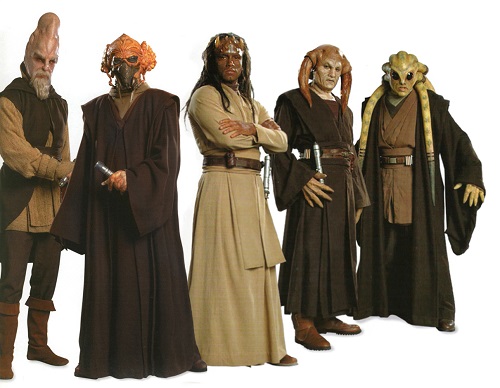
It is not impossible to develop individual characterization in this situation. A sharp writer like John Ostrander can do a great deal to set Jedi characters apart with strong personalities and genuinely unique story roles. But most prequel Jedi, even the better-characterized ones, are not quite as distinctive as Ostrander’s. Qui-Gon is distinct from Obi-Wan in outlook and attitude — but he is not nearly as different as he could be. Given twelve Jedi at once in the form of the Jedi Council, creators did an admirable job of trying to develop some sense of distinction in personality and specialization — but they couldn’t escape the fact that they are stuck doing variations on the same basic template. You could switch out Eeth Koth, Saesee Tiin, Kit Fisto, Ki-Adi-Mundi, and Adi Gallia in most stories and not notice any difference at all. The restrictions on storytelling potential are real and significantly limiting.
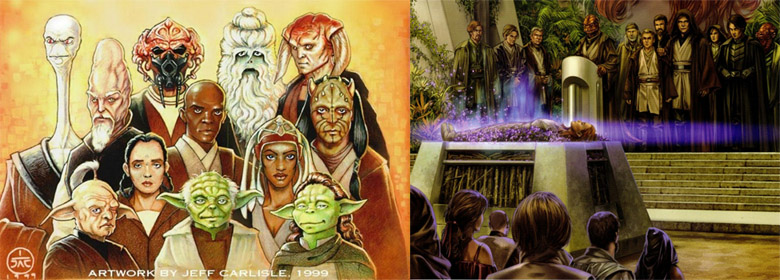
One of these Jedi Councils is visually diverse. The other is diverse in character.
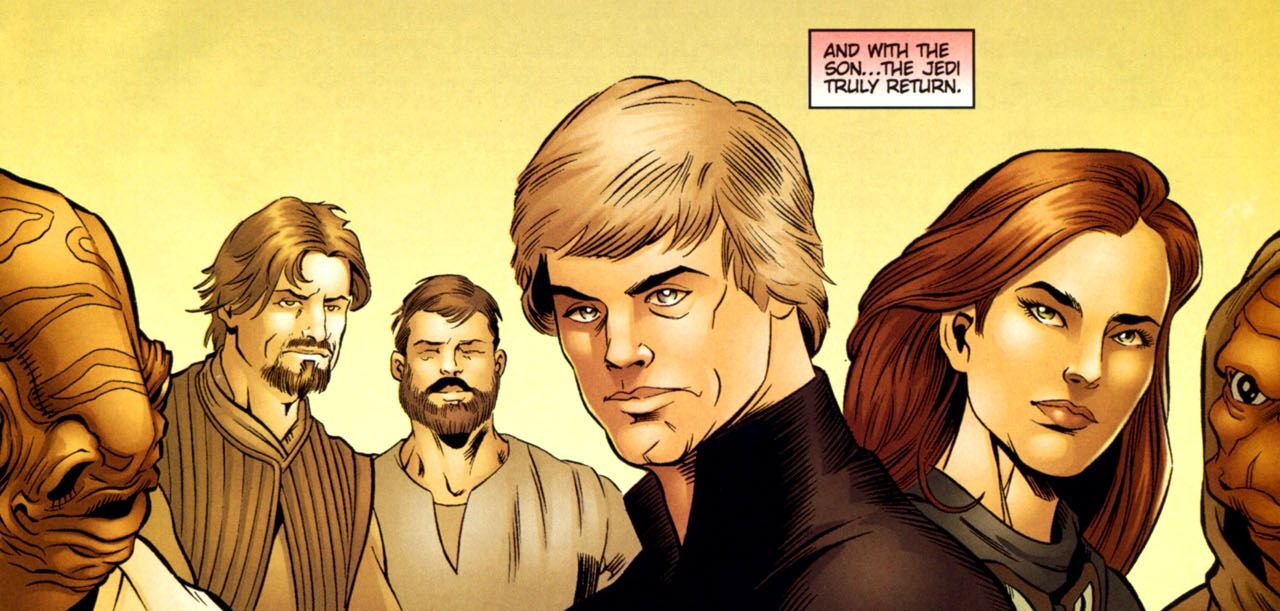
The prequel Jedi Council of twelve prequel Jedi — one of whom is a little more aggressive than the others, one of whom hasn’t taken an apprentice and is a great pilot, one of whom knows Chancellor Valorum, etc. — is a significant change from the Jedi Council of the New Jedi Order — a married couple consisting of a sweet-natured farmboy fighter pilot and a harsh-but-loving reformed assassin/spy/smuggler, a hard-bitten veteran commando with a history of struggling with the dark side, an intensely practical detective/Starfighter Command colonel married to a smuggler, a reformed Dark Jedi and his musician wife, a bachelor ex-slave miner who committed genocide in a vendetta over his family, a gentle healer with a political background, etc. Mike Cooper will point out that the prequel Council is much more visually diverse, but it is the New Jedi Order Council that is vastly more diverse in character.
This distinction is especially clear in the creation of brand-new Jedi protagonists. Jedi created outside the prequel context during the New Jedi Order still had distinctive characteristics. Kenth Hamner was an ex-fighter pilot and current military liaison, which informed his by-the-book, law-and-order personality and his administrative, diplomatic, and leadership expertise. Saba Sebatyne was raised in Barabel culture, giving her a distinctly alien personality and the mindset of a hunter. Wurth Skidder had no particularly unique background, but was infused with a headstrong, cocky personality and a particular agenda to take the fight to the enemy. Ganner Rhysode was an arrogant, narcissistic Jedi who saw himself as a naturally superior hero before he got his ego under control.
Ben Skywalker’s time in the Galactic Alliance Guard gave him military and police training and time with non-Force-sensitives, helping set him apart from his generic fellow Jedi in characterization and skills.
Post-NJO, when the prequelization of the Jedi took hold? Quick, tell me the difference between Valin Horn, Jysella Horn, Natua Wan, Kolir Hu’lya, Seff Hellin, Doran Tainer, and Thann Mithric? If you answered, “I don’t know,” you’re correct! All are born Jedi who have never done anything other than hang around the Temple and go on Jedi missions, which Troy Denning increasingly further genericized as purely commando strikes and StealthX fighter operations, in which all Jedi are blandly and uniformly competent.
Other prequel-influenced stories like Scourge, Fatal Alliance, Dark Times, Red Harvest, and Crosscurrent have struggled to make their Jedi protagonists stand out as characters. Their creativity seems crippled by adherence to the generic career-Jedi norm. Even the efforts to subvert that norm have been so hemmed in by uniformity as to spawn a new trope — the plucky-but-underpowered young female Jedi trainee who lacks confidence and worries about washing out. See Darsha Assant, Etain Tur-Mukan, and Scout.
In conclusion
The painful truth is that the Jedi-from-birth template, especially as exacerbated by Troy Denning’s tendency to run roughshod over any distinctions in Jedi roles in favor of making them interchangeable commando-pilots, produces cookie-cutter Jedi characters. They have the same life experiences and the same basic outlook. Their options for character definition are restricted by the removal of so many tools for diversification from the author’s toolbox, and the uniformity of the pattern discourages further innovation in all but the most creative authors. The unchecked spread of the Jedi-from-birth prequel model across the timeline and into authors’ heads must stop. It’s time for authors to return to diversity in background and role for Jedi characters. Their characters and stories will be so much richer when they do.
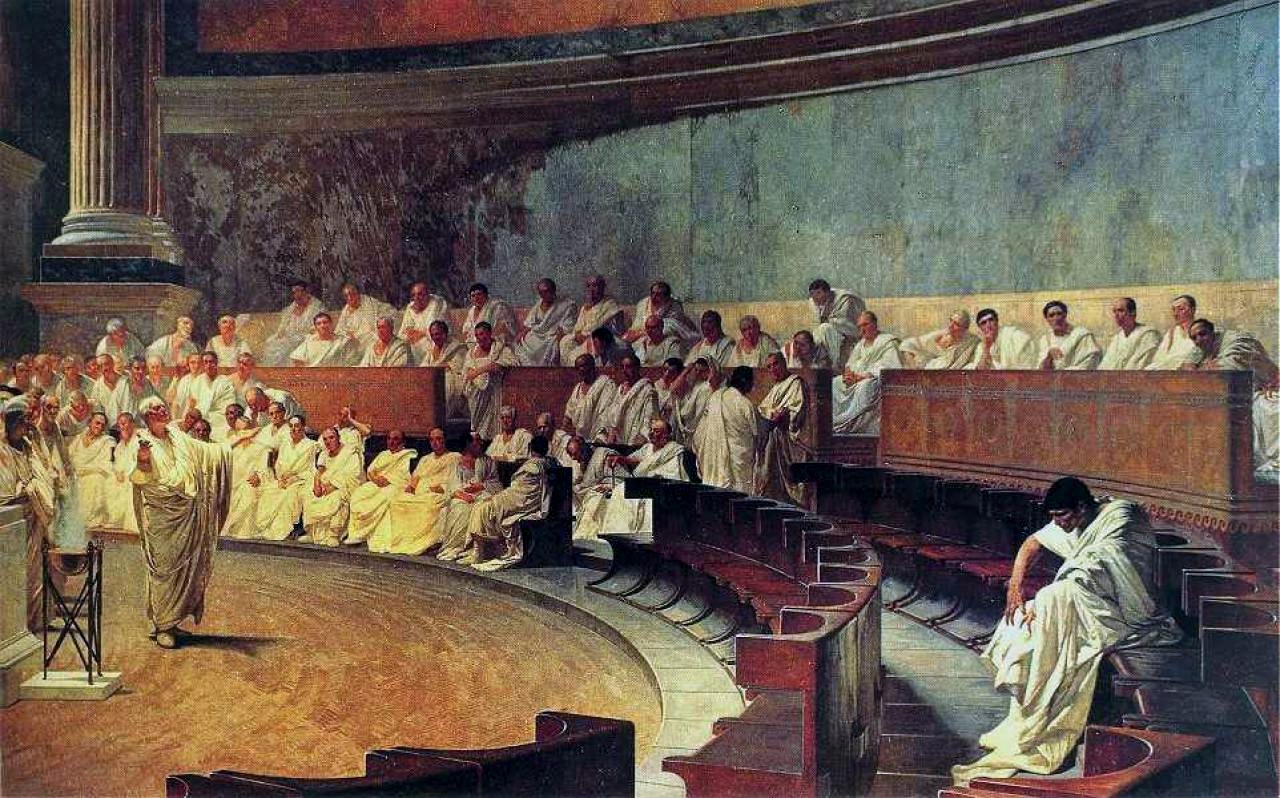
A Republic is formed in a central region, is led by a Senate, undergoes a great period of expansion, fights wars against nomadic invaders and its cultural antecedents, and transitions from a republic to an empire under the direction of a charismatic leader who outlived his detractors. Many storylines and facets of various fantasy universes draw on Roman history, from the Malazan Empire of Malazan Book of the Fallen and the Septim Empire of The Elder Scrolls to the the Valyrian Freehold in A Song of Ice and Fire. Star Wars is no different in this regard. Several significant similarities exist between the Galactic Republic and the Roman Republic, from their languages to their enemies.
Lingua Franca Galactica
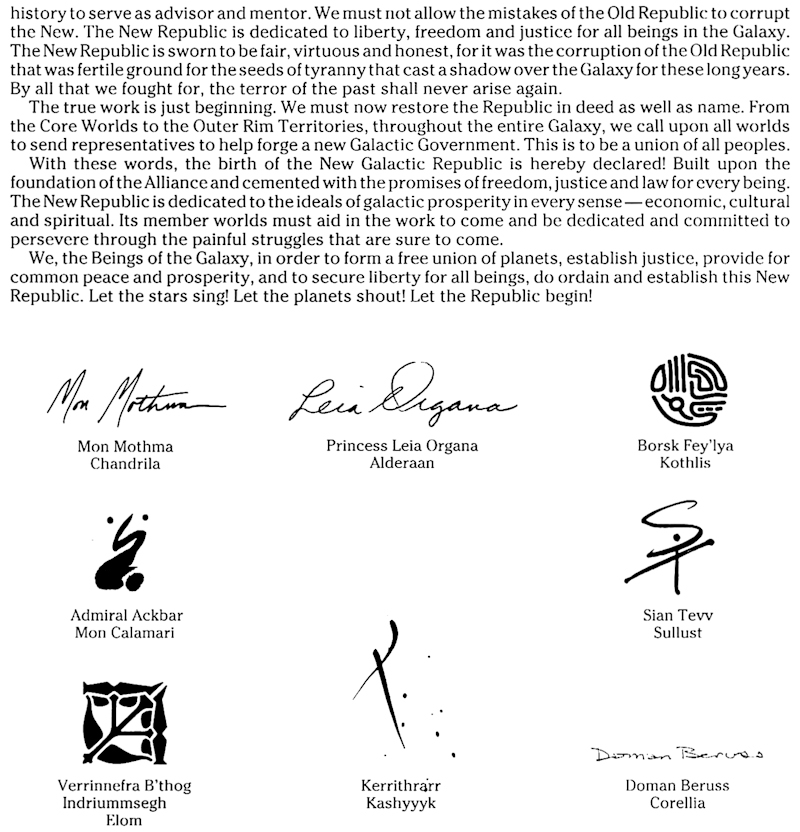
The Latin alphabet has been canonized within the Galaxy Far, Far Away as the ancient language of the Republic. For years, Latin letters have appeared in the EU- see, for example, the signatures on the Declaration of a New Republic. Latin was canonized as the High Galactic Alphabet by John Hazlett, known to TF.N posters as jSarek, in his article The Written Word. High Galactic originated with the Alsakani, one of the founding cultures of the Republic. Within the GFFA, it is still used for signatures, droid designations (note that, to paraphrase Dan Wallace, we never refer to a certain smarmy astromech as ReshTwo-DornTwo, or his flighty counterpart as Cresh-ThreePethOsk), and names of starships. Whether or not Latin itself exists within the GFFA is debatable. While various Latin and pseudo-Latin names appear frequently in Star Wars– the Imperial Navy is replete with vessel classes such as the Praetor, the Acclamator, the Venator, and the Imperator— such words could also originate other Core World tongues.
Senatus
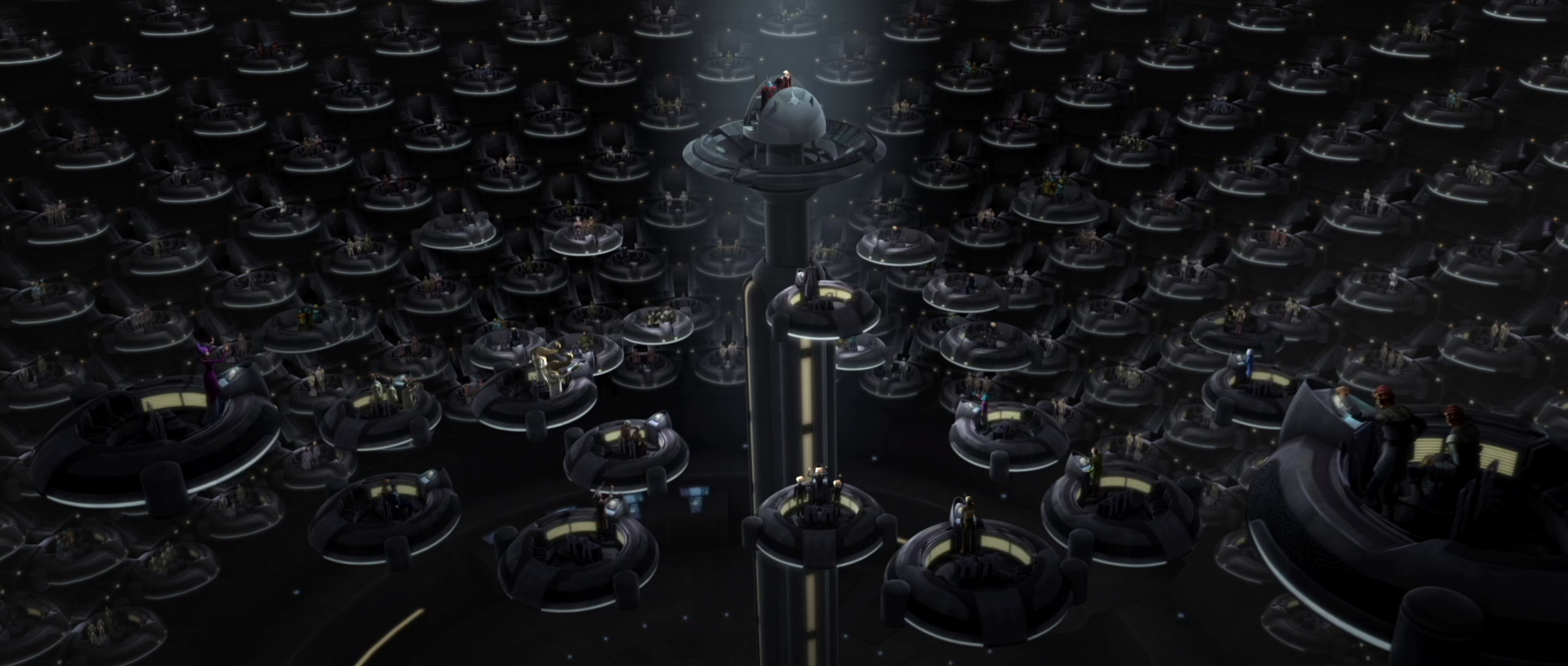
Like the Roman Republic, the Galactic Republic was governed by a Senate. The Senate was led, of course, by the Supreme Chancellor. While many of the details of the office of the Supreme Chancellor align more closely with modern European prime ministerships, it is notable that the Chancellor’s office was represented by a fanned spear, similar to the fasces, the symbol of the authority of the consul (The fasces was an axe surrounded by a bundle of sticks, symbolizing the power of a Roman consul or dictator to dole out capital punishment, if necessary). Notable differences exist, however, between the Galactic Senate and the Roman Senate. In particular, the manner of representation differed greatly between the two organizations. The Galactic Senate was composed of representatives from member worlds, systems, or regions. Every region had explicit representation in some form or another. Elections were usually left up to the individual star systems. In contrast, the Roman Senate under the Republic was appointed either through the censors or by election to a magistracy. There was no Senator of Achaea, no Senator of Mauretania- it was a Senate of, by, and for the Romans.
Socii
One of the many fascinating sections of the Essential Atlas dealt with the Allied Regions, semi-independent sectors within the Old Republic. Allied Regions often originated as the domains of early adversaries of the Galactic Republic who chose accession over violence, and were generally left to govern their own affairs. Many of the Allied Regions could be found along what had been, at various points in time, the Republic’s frontier. Allied states were also a staple of Roman administration, first in Italy and later along the frontier. During the Republic, many of the Italic cities constituted autonomous states within the Roman Republic complete with their own citizenship, language, and local governance. In exchange for obeisance, taxes, and troops, these cities were largely left to govern their own affairs. Along the frontiers of the Republic- and later, the Empire- allied client kingdoms were established in sensitive regions that the Romans did not wish to directly control. Rather, Rome ruled through client kings (who often had Roman citizenship) in areas such as Bithynia and Armenia. The Galactic Empire had similar arrangements with Hutt Space and the Corporate Sector.
I Fear the Tionese Even When They Bear Gifts
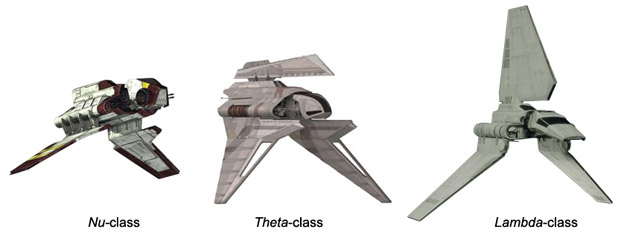
The enemies of the Galactic Republic at times bore a striking resemblance the adversaries of the Roman Republic, and to a lesser extent the Roman Empire. Early on in her history, the Republic fought a series of vicious clashes with polities in the Tion Cluster. The Tion were already an ancient human culture by the year 24000 BBY, and Tionese culture had influenced much of the rest of human culture in the GFFA– certain Core worlds, such as Alsakan, even believed themselves to be Tionese colonies. However, by this point in time the Tionese had entered a long decline- Xim was long dead, the Hutts had ravaged many of their worlds, and the cluster itself had fractured into feuding polities. The Tionese War ended in a resounding Republic victory, as the Republic glassed Desevro. This conflict rather resembles the Macedonian Wars, a series of wars fought by the Roman Republic in the 2nd Century BCE against the Antiochids of Macedonia. Like the Galactic Republic, the Romans were fighting an enemy who had exerted a great cultural influence over them- a culture that was perceived to have fallen from a putative golden age and returned to a set of small feuding city-states and kingdoms following the death of Alexander. Jason Fry’s Xim Week and John Hazlett’s The Written Word pretty firmly established the Tionese as Hellene analogues in the GFFA (more on that next time), going so far as to officially canonize the ancient Greek alphabet as the Tionese language (thereby explaining the presence of Lambda-class shuttles and Delta Squad).
Mandalorians at the Gates
Thousands of years later, the Republic would clash with nomadic invaders from the Outer Rim: the fearsome Mandalorians. The Mandalorians would take part in several wars against the Republic, wreaking havoc from Dxun and Eres III to Duros in the Galactic Core, and even briefly striking at Coruscant itself during the Great Sith War. The Mandalorians were originally portrayed as a staple fantasy nomadic warrior culture- something of a cross between the Vikings and the Mongols. In recent years- particularly since Karen Traviss gave her own take on the Mandalorians- the trend has moved more towards portraying the Mandalorians as Space Celts. And the Romans were quite familiar with fighting Celtic cultures. To the Romans, the Gauls were a cultural bogeyman similar to the role played by the Persians in the Greek psyche. Traditionally the Gauls had harried the Romans from Northern Italy for centuries- in 391 BCE, the Gauls even managed to sack the city of Rome itself. On a more general level, the clashes between the Republic and the Mandalorians are reminiscent of the wars between the later Roman Empire and nomadic groups such as the Franks and the Goths. Notably, both the Mandalorians and the Goths served as mercenaries for the very governments they famously fought.
Transition to Imperium Galacticum
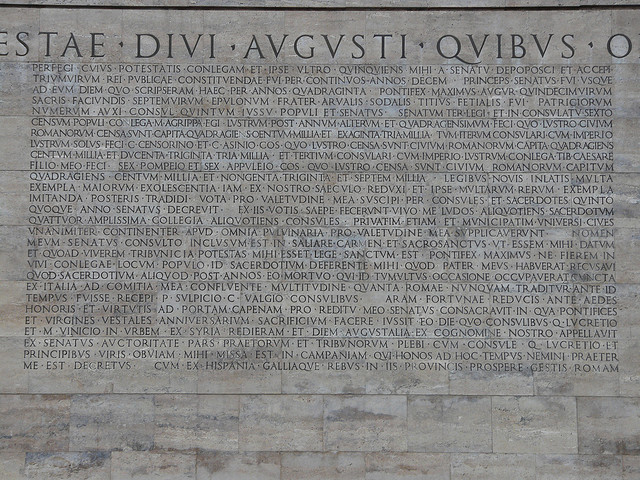
The earliest canonical mentions of the Old Republic are found in Episode IV, when Tarkin informs the rogue’s gallery of admirals, generals and Sith Lords aboard the Death Star that the Imperial Senate has been disbanded, and “the last vestiges of the Old Republic have been swept away”. The prequels would later elaborate on the transition from Republic to Empire, a transition which occurred at the behest of one Chancellor Palpatine- a figure who was inspired by many historical figures, among them Augustus Caesar. Augustus was able to engineer his election to the consulship soon after the assassination of Julius Caesar in 44, and utilized his position to eliminate his opponents and consolidate his hold over the Roman government. Most of his powers were in fact voted to him by the Senate- during the Second Settlement tribunician power was granted to him, as well as censorial power (Tribunican power gave him the power to propose and veto legislation, while censorial power allowed Augustus to appoint and dismiss senators. This all was in addition to the executive powers he held as consul.). During and following his consolidation of power, Augustus embarked on a series of military campaigns throughout the Mediterranean world, incorporating new areas into the Empire and reasserting control over regions where control had been tenuous. All of which should sound very familiar to the career of Chancellor Palpatine. Like Augustus, Palpatine was able to effectively rewrite the history of his rise to power in order to suit his needs– Palpatine portrayed the Jedi Order as the perpetrators of the Clone Wars, as well as suppressing or rewriting accounts that contradicted his narrative. Augustus, in his Res GestaeDivi Augusti (The Accomplishments of the Divine Augustus- the funerary inscription listing Augustus’s achievements) whitewashed his actions during the Second Triumvirate and the Civil Wars, glossing over the widespread murders of his political opponents while trumpeting how he “brought peace” to the Roman people.
Conclusion
While it lacks a Romulus-style foundation myth, the Galactic Republic nevertheless followed many of the precedents set by the Roman Republic. The Galactic Republic’s enemies took many cues from the Roman Republic’s enemies, from culture and language to their own history. These kinds of historical references abound in the Star Wars films and Expanded Universe, and are likely to appear in Disney’s iteration of the franchise as well.
Next time on A Long Time Ago, Tyler will explain why the Tionese are Space Greeks and how Xim the Despot is a less competent Alexander the Great with beam-tube technology.
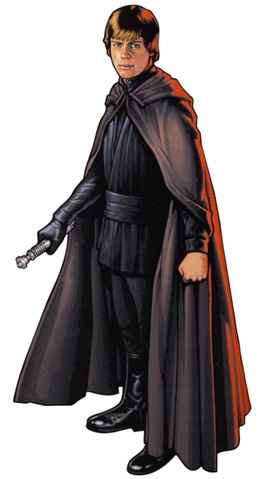 Let’s face it and bring it out into the open now. History is going to repeat itself and Episode VII is going to bring us the death of Luke Skywalker. Shall we review? In Episode IV we see the death of the Force-using mentor to the protagonist (Ben’s death to Luke as the hero). In Episode I we also have the death of the Force-using mentor to the supposed hero or heroes (Qui-Gon Jinn to Obi-Wan and Anakin as the heroes). This is a classic move that enables the up and coming hero to actually become the hero. In each instance the Force-using mentor died at the hands of a Sith opponent and if you read the roundtable discussion on who we think the antagonists for the ST will be we pretty much agreed that a Star Wars movie is not a Star Wars movie without the clash of the red lightsaber with a variety of different colored lightsabers.
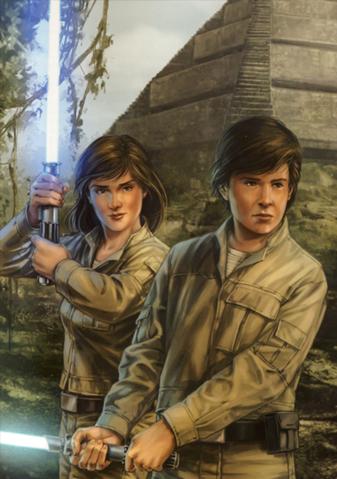 In order for the death of Luke Skywalker to be a viable option for Episode VII the creators need to be ready with a likeable, believable second mentor to fill the hole caused by the death of Luke Skywalker. This would actually be a good fit for several Expanded Universe characters to be included or even a child of Han and Leia (provided that the movies go along with them being together still). Luke was able to keep training because he was told to go to Dagobah where he found Yoda. Anakin was able to train because Obi-Wan Kenobi was there to step into the mentor role. The next generation of Jedi is going to be no different.
 Star Wars is violent. Wars bring death and destruction. I expect nothing less from Episode VII.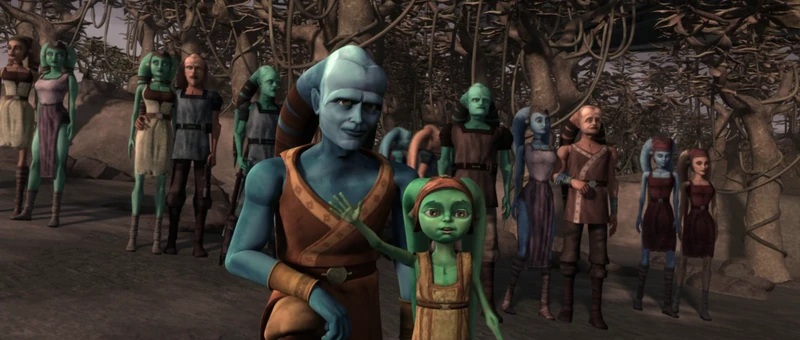
 Enter Timothy Zahn. In 1991 Heir to the Empire unveiled Borsk Fey’lya, one of the earliest members of the Rebel Alliance, pillar of the New Republic government, and perhaps most interestingly, gigantic douche. Fey’lya added new depth to the “ambiguous bad guy” role invented by Boba Fett by undermining the heroes at every turn—including getting Admiral Ackbar arrested—while simultaneously being a figure of great significance to the Rebel cause and, frankly, not a totally-unreasonable dude.
 The plus side of this relative inconsistency is that if some seven-figure screenwriter felt like putting Bothans in a movie down the line, they’d have a fair bit of leeway to tweak the design to their tastes; after all, even a slavishly EU-faithful movie Bothan wouldn’t match all the existing imagery.