Rest in Peace, Aaron Allston

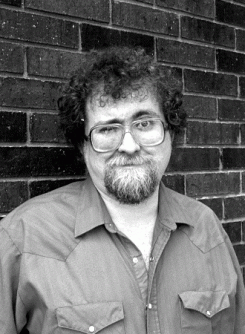
AaronAllstonAs you’ve likely heard by now, longtime Star Wars author Aaron Allston passed away suddenly yesterday after collapsing at VisionCon in Branson, Missouri. The news came late last night and threw us all for a bit of a loop, so we’ll be taking an extra day off to collect our thoughts, and we’ll be back with those on Monday.
Our thoughts are with Aaron’s friends and family, including the seemingly limitless number of fans who had the pleasure of getting to know him at a convention or three. Aaron wasn’t just one of our franchise’s best writers, he was one of us.

Yub yub, Aaron. And frothing disease to your enemies.

Antagonism: Heroes on Both Sides

649_200808071737

As one might surmise from the name, Star Wars is fundamentally a story of conflict. As is the case with most such tales, the plot is driven primarily by two major opposing forces: the Galactic Empire and a certain ragtag band of rebel heroes (and, in the prequels, the Separatists and the Republic). Each side is represented onscreen by a cast of unique and memorable characters, but it is also worth noting that being unique and memorable does not necessarily equal being interesting, especially when we’re talking about the antagonists.

People will long remember Darth Maul, not for any clever characterization or witty dialogue (of all the main antagonists of the saga, he might have the least dialogue of any), but because he wielded a double-bladed lightsaber and had horns growing out of the top of his head. In fact, for all that the saga is trumpeted as the rise and fall and redemption of Anakin Skywalker, its approach to villains and their villainy is often ham-fisted at best and cringe-inducingly cartoonish at worst.
Read More

Everything I Know About Life I Didn’t Learn From Star Wars!

sw_muppets

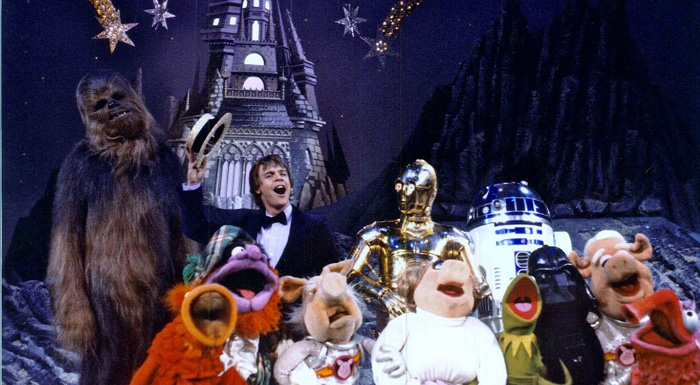
Are you not entertained? Let me think about that for a moment before giving a thumbs up or down. There are times, as I’m trawling the net, that I wonder when exactly entertainment, in itself, became less important. I also wonder where the idea came from that people are so easily influenced as to follow everything they see in a story. These two ideas are quite distinct but have surprising links between them. When Star Wars went off the rails with the Prequels, I find it hard not to see the clear desire for them to be more than merely entertainment playing a major role in the crash. Why would the Prequels need to be anything more in the first place? In part due to that narrow notion and delusions of influence as to how far people follow a story.

It might be said that there is a cultural plague of seriousness, it may be said to have started after 11 September 2001, but it was around before then too, the events of that day just granted it sharper focus and latitude. The problem is Star Wars, to the core of its being, is entertainment. It is not constructed to withstand the kind of scrutiny that comes with making serious claims – that’s where the now infamous Clerks Death Star contractors riff gets started, but without the customer put-down that those contractors knew what they getting into. Equally it isn’t really concerned with the horrific realities of life in a totalitarian society. Contrary to what its critics may claim, neither of these is a bad thing!

Read More

Rebels, Kanan Jarrus, and the Race Factor

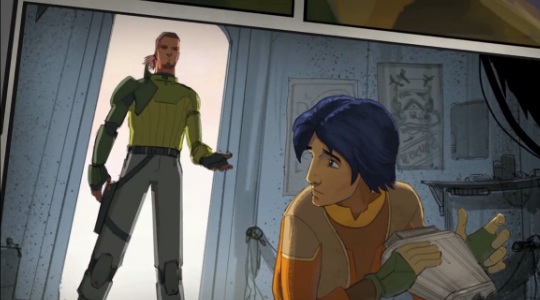
As the last episodes of Star Wars: The Clone Wars find their way into the light of day, one era of televised Star Wars comes to a close and a new one dawns. The Clone Wars are over, the Empire has risen, and the dark times are upon us as Star Wars: Rebels prepares to premiere this fall. Slowly but surely, we’re learning what Rebels has to offer the Star Wars universe, including a cast of characters that appears as diverse in origin and personality as they are of ethnicity.

While the creative team behind the new series first tempted fans with images of the new villain—an Imperial Inquisitor, a chalk-white and black armored member of the Pau’an race—and showed off the cantankerous little astromech droid named Chopper, our first real look at the flesh-and-blood heroes of Rebels came in the form of the Jedi-in-hiding Kanan Jarrus. Kanan’s story is a familiar one to fans of the Star Wars Expanded Universe: a Jedi who escaped Order 66 flees into the unknown, growing distant from the life he’d led in order to evade the dangers of the Galactic Empire’s Jedi purge. What separates Kanan from the likes of Dark Times’ Dass Jennir or Coruscant Nights’ Jax Pavan, is that Kanan, whom early reports posit as the unofficial head of Rebels’ group of protagonists, appears to be a leading man of color.
Read More

Rebels, Greg Weisman, and the Disney Factor

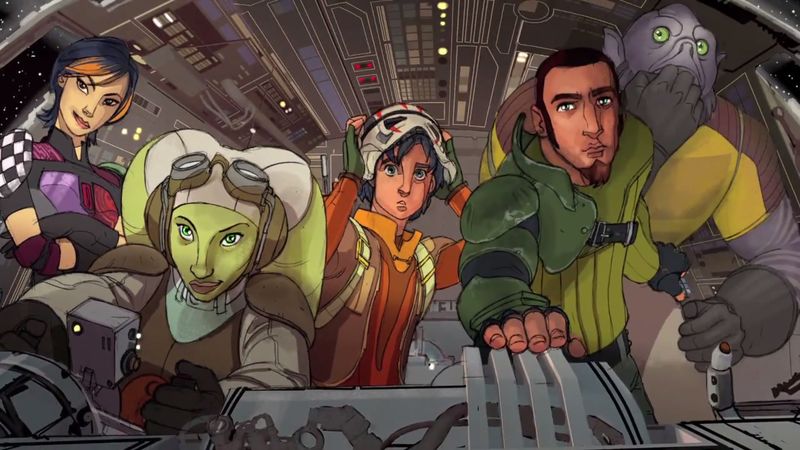
Ghost_crew_shenanigans

As more and more information has been revealed about the upcoming TV show Star Wars: Rebels, including a couple of recent teaser trailers, a fissure has opened in the fandom. Just like The Clone Wars before it, the prospect of an animated series oriented toward a younger audience has a polarizing effect on most fans. A sampling of YouTube comments on the recently released teasers (not usually a healthy practice) shows a clear divide, with some voices praising the return of beloved elements like TIE fighters and stormtroopers, while others complain about the prospect of a teenaged character in one of the lead roles, already decrying the show as looking worse than TCW.

Of course, all of this is speculative and uninformed, since as of the writing of this article, the show is still several months away from airing. We know almost nothing about what the plot or arc of the show will be, and nothing about any of the cast aside from three character profiles and leaked pictures of toys. All we know for sure is who will be working on the show behind the scenes: Dave Filoni, who headed up The Clone Wars after Henry Gilroy departed in season 2, Simon Kinberg, writer of X-Men: First Class who is involved with the story of both Rebels and (according to rumors) the live-action movies looming on the horizon, and Greg Weisman, writer and producer of numerous lauded and praised cartoons over the years.
Read More