When we first laid eyes on the New Republic, it appeared to us as a child just emerged from infancy. We fed it from our wallets and watched it grow with each new entry. We saw it survive and thrive against all odds in a hostile galaxy. We continued to follow the course of its nearly two-and-a-half decade existence until its eventual demise at the hands of the Yuuzhan Vong and its rebirth as the Galactic Federation of Free Alliances. Much has been said about its life and death, but the Expanded Universe has long remained unusually silent on the circumstances of the New Republic’s creation.
To say overthrowing an entity the size of the Galactic Empire is a difficult task would be a significant understatement, but the process of building a new state remains a far greater challenge. Stories such as the X-wing series, the Thrawn Trilogy, and The Courtship of Princess Leia have told tales of the fledgling government’s conflicts against Imperial holdouts such as Ysanne Isard, Grand Admiral Thrawn, and the warlord Zsinj, but these are primarily military conflicts against external forces – a simple continuation of the Galactic Civil War with foes other than Palpatine and Vader. Read More
In an interview with BBC earlier this year, J.J. Abrams explained that his approach to the new Star Wars films centered more on what he thought was authentic to the characters and less on what he thought the fans might want to see. In doing so, he explicitly drew a contrast between having an authentic creative vision and trying to divine the preferences of fans. It’s not immediately clear that there is any such dichotomy between a well-crafted film and a film which caters to the whims and desires of the fan base. While a quality creative vision is paramount, is J.J. Abrams correct to draw a contrast between what fans want and what’s best for the films? Despite the sometimes pejorative usage of the terms fanboy and fangirl, aren’t they occasionally correct in their vision and isn’t supporting the fandom a sign of an attentive franchise? We say yes.
We often hear the term “fan service” used to describe a certain kind of pandering to the fans, usually involving the display of flesh. The archetypal example in Star Wars is Princess Leia’s metal bikini in Return of the Jedi, but fan service of that sort can be seen across various types of media: from comic books and character illustrations to racy writing.
Leia’s metal bikini has become almost a byword for fan service, parodied in movies and television and yet still easily exploited for sales.
It’s often used to describe women – usually fan favorites – in skimpy outfits, but it can also be used to describe men in similar conditions or even unnecessary plotlines featuring romance or violence. The defining characteristic of fan service is that it is gratuitous and it is geared towards pleasing fans, and therefore driving sales of a product.
We asked our friends and colleagues for a word that describes the opposite of fan service, which would be something along the lines of being attentive to the needs and concerns of fans: something more than dismissiveness and less than pandering. Nobody could come up with a handy term, and responses ranged from “good writing” to “being thoughtful and treating your fans like intelligent people.” It’s telling that this sort of thing is so uncommon that it doesn’t have a label, but we argue that it’s crucially important for successful franchise work. For lack of a better term and to avoid circumlocuitousness (spellcheck, if that isn’t a word, it ought to be!), we’ll stick with fan engagement.
What is fan service exactly?
Since we’re talking about a continuum between a good level of engagement with fans and fan service, we have to reject extremes at the outset. Our position is not that the display of any sort of flesh, that any romantic plotline, or that any use of a fan-favorite character is necessarily fan service. It’s a question of degree, and perhaps more importantly, a question of purpose. We state a proposition that we assume is not terribly original, yet it becomes all the more surprising that blatant fan service still exists in spite of it. We propose that the difference between fan service and fan engagement is that fan service involves pandering to the audience in a way that does not actually enhance the story or creative version – in other words, the paramount difference between the two is actually more about purpose than degree.
This is an important distinction, especially when it relates to sexuality or nudity. Franchises – especially those in the science fiction or fantasy genres – often feel the need to exploit sexuality in order to make their content more palatable to mainstream audiences. Not only is this assumption unwarranted with the success of science fiction and/or fantasy blockbusters such as the Star Wars films themselves, or the more recent Trek reboot and the Game of Thrones television adaptation, not only does it offend both casual and hardcore fans and followers of the same, but it is often thematically and narratively unnecessary. This is the key: while some would argue that all sexuality and/or nudity is obscene, unseemly, and unnecessary, we argue that it is only that which is pandering that is problematic. It is that pandering that creates a host of extra problems which have long plagued media properties: problems of sexism and the male gaze, issues of privilege and objectification, and – for some – even issues of moral decay. Why is pandering problematic? Because fan service is – by its nature – unnecessary. It is when creators and designers make a decision to make a thing “sexy” merely for the purpose of pleasing fans who drive sales, and for no other underlying goal. This underlines how cheap and instrumental such sexuality is, which is why so many of these problems (each of which could probably sustain its own article) get reinforced: because said sexuality and nudity is monetized, and that is its only value.
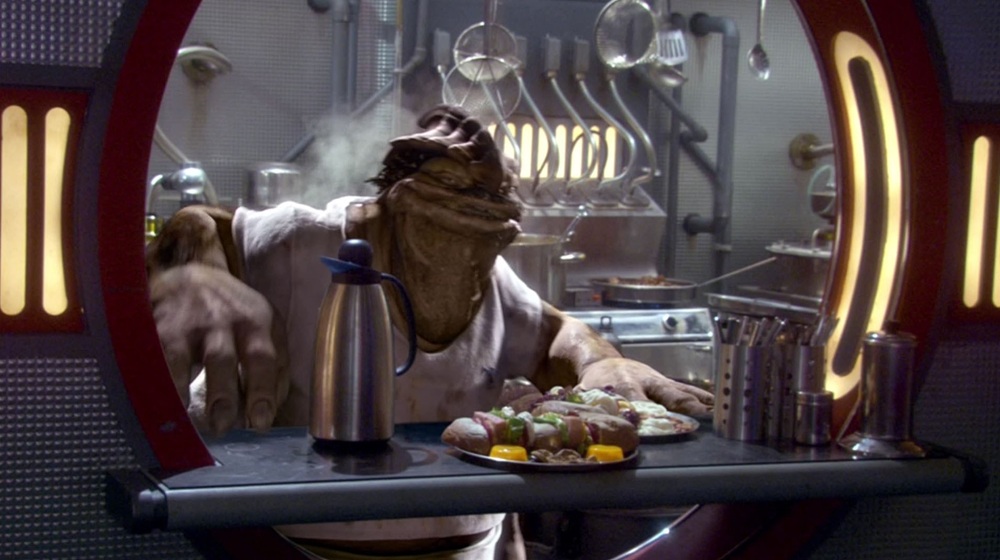
Dexter Jettster shows a lot of skin, and his service is known for being very profitable.
We do not advocate censorship or bowdlerization, however. Ours is not a moral point, and we do not wish to see a Victorian ethos in the Star Wars franchise (unless that involves a steampunk aesthetic, which is almost always cool – but it too, can be overdone). Sex, nudity, revealing costumes – all of them can serve vital narrative purposes, can establish a dramatic setting, and can be used creatively. In our modest opinion, the problem has never been with their presence in franchise work but that they were used for pretty exploitative purposes. Note well, creative types, that a narrative purpose does not simply mean that a character dresses in a skimpy outfit because it “empowers” him or her (but note also that such a thing is also not impossible: such people do exist, but make sure it is about the character and not about pleasing the fans who will buy your work!).
Not just sex
Some of the friends we surveyed used the term “fan service” to exclusively refer to the sexualization of characters and scenes, while other sorts of pandering were called just that – pandering. We subscribe to the broader view of fan service, which includes gratuitous violence, gratuitous romance, or even gratuitous character appearances. For us, it’s never just been about sex: but anything that is primarily geared at pleasing the fans to drive sales, at the expense of narrative concerns.
Fans often complain of unnecessary love triangles, and romance plotlines are often stretched out beyond all reason in order to drive sales from fans who favor relationships between differing couples (beware: few wars leave fewer casualties than shipper wars – appeal to fans by inserting relationships at your risk, creative types, as people have been known to leave franchises when their ship sinks!). This is a problem that has plagued more than just franchise work: network television soap operas and even a few sitcoms have long been known to use this method of fan service, and entire series have spawned out of romantic fan service.
Let’s get concrete. We’ll use Boba Fett as an example. His very existence as a character has to do with his popularity with the fans: he began as a random character in the Holiday Special, had a small role in The Empire Strikes Back, and drove such action figure sales that he had a sizeable role in the beginning part of Return of the Jedi. Then he died. But he was shortly revived by the Expanded Universe, and continued to play a role into the very post-ROTJ Legacy of the Force series as well as a role in the Star Wars prequels and associated comics and video games (to the point that the character Jango Fett was created to tap into his fan base while the actual character was too young to be fighting). Boba Fett is incredibly popular, and that has caused him to appear in settings where he might not properly belong. Some have protested his inclusion in the Legacy of the Force novels, while others have argued that his story arc in those novels is well-written and compelling enough to warrant his inclusion aside from his popularity. As we have not read that series ourself, we could not possibly comment. We will observe that sometimes the line is difficult to draw: the most excellent comic by the most excellent John Ostrander – Agent of the Empire – featured what at first struck us as an annoying bit of fan service: the introduction of Boba Fett for no reason than to justify his placement on the cover of the comic. Yet as the narrative unfolded, it turned out that Fett did have a role to play in the story. Did that mean the financial considerations of his placement were out of the creators’ minds? Of course not – but we acknowledge that business considerations are important and will inevitably play a role. We just ask for some restraint and discipline.
It’s a fine line to draw, and the very nature of franchise work is that inevitably someone, somewhere, will object to something as inappropriate, or as pandering. The key is to have honest motivations and intentions. Give fans some credit: they can tell when they’re being pandered to. Some fans are fine with that and would like to be pandered to, and there’s not necessarily anything wrong with that (but as noted, there can be problems with objectification of people, trivialization of violence, misleading and unhealthy views of romance, et cetera) but plenty of fans will resent it.
What is fan engagement?
So how is fan engagement done right? This is a harder question. Giving fans what they want is sometimes exactly what is called for: Marvel’s The Avengers succeeded largely in part because it was what everyone wanted and expected from a superhero film of its nature – but did not pander, because its entire premise was that it was a fun superhero film that did not take itself terribly seriously. If it had attempted to cash in on Nolan Batman films’ narrative weight, it would have probably struck viewers as artificial and not have succeeded as well as it did.
The best recent examples of fan engagement from Star Wars at our disposal come from recent Expanded Universe offerings. From novels to reference materials, the Star Wars EU has been getting it right lately. A few years ago, Matthew Stover penned Luke Skywalker And the Shadows of Mindor – its campy title foretold what the story would end up being, which was essentially a love letter to the fans of the old and sometimes maligned Bantam-published EU of the 90s. It was retro in a way that appealed to nostalgic fans, but in a way that strongly enhanced rather than undermined the nature of the story: hammy and over the top was exactly what the story and its villain called for, and Stover delivered in spades. The fans that enjoy Star Wars reference materials inhabit a bit of a niche in the Star Wars fandom, but that hasn’t stopped EU writers from delivering. Writers such as Dan Wallace (writer of The Jedi Path and The Book of Sith) and Jason Fry (The Essential Atlas, alongside Dan Wallace, and The Essential Guide to Warfare, alongside Paul Urquhart) have written reference books that had glitzy and glamorous designs, and the Jedi/Sith books even featured little inserts and toys to drive their appeal. They were well-publicized books which aimed at a mainstream audience (as far as Star Wars fans go), but the authors of those works also regularly conversed with the niche fans of EU arcana on messageboards and social media sites in order to capture the pulse of that segment of the fandom: they were consequently able to both create works geared at selling well but showed by their conduct and writing that the views of the fans were very important to them. Even the StarWars.com blogs have joined in on positive fan engagement – a series of articles written by individuals such as Abel Peña, Rich Handley, Pablo Hidalgo, James McFadden, and many others have added both new lore and shed light on previously unknown facets of the Star Wars mythos and moviemaking process in ways that have fascinated and delighted fans of such: and they’re doing so on a completely free website feature.
Fan engagement is good. We want to see creators more responsive to fans, but in a way that showcases their appreciation of both the franchise they work in as well as the fans of that franchise. Fans can be pretty harsh critics and some people have said some pretty awful things about people who work in the Star Wars franchise, but ultimately we’re all seeking the same thing: the best Star Wars franchise we can have. We hope, looking forward, that J.J. Abrams realizes that it is perfectly ok to approach his work as a Star Wars fan – as we know he is – without undermining his creative integrity or that of the franchise. After all, many of the individuals we have praised in this article are fans themselves: this is how we know the franchise is in safe hands with them. That’s not to say that fans always make the right decisions or what fans want is always the best, but creators who are fans themselves and who think of the fans as actual people are probably in a better position to make those decisions. Mr. Abrams just needs to set the right course between too much pandering and too little: but that’s what astromech droids are for. You can never have too much Artoo Detoo.
Now over a year in the making, it’s time for the final volume of the Pithy Reader’s Companion! Our voyage begins with the arrival of the Yuuzhan Vong and the untimely demise of the mighty Chewbacca, and continues into the far, far future of the Skywalker family in the Legacy comics.
Fun fact: This batch almost certainly covers the time span where the sequels will be set, and as such is probably the stuff most likely to be erased from continuity—which is a damn shame for some of it, and frankly a relief for others. The exact proportions thereof may vary, of course; you can probably guess which ones @Havac (our own Lucas Jackson) would most like to get rid of. Enjoy!
Vector Prime – The book with one simple message: Chewbacca’s dead, Mara’s deathly ill, and incredibly dangerous biotech-wielding Forceless aliens are invading the galaxy — DEAL WITH IT. – @Havac
Dark Tide: Onslaught – The first of many NJO covers which depicts things that never actually happen in the novel. – @GrandAdmiralJello
Dark Tide: Ruin – Introducing Jagged Fel, the on-again-off-again-on-again-off-again-on-again-off-again paramour of Jaina Solo for the next twelve real life years. – @GrandAdmiralJello
Agents of Chaos: Hero’s Trial – Han Solo’s Magical Mystery Tour of Forgotten Classic-EU Supporting Characters. – @Havac
Agents of Chaos: Jedi Eclipse – Despite the cover, this book does *not* detail the Han Solo/Tsavong Lah buddy-cop comedy of the year. – @RC-1991
Balance Point – The most cleverly titled book of the series had no balance and no point. – @DarthRelaxus Read More
I received one last question from my friend Pearl (she of EU Explains Vol’s I and II). This was easily the meatiest bone she’d thrown my way thus far, so I thought I’d tackle it all on its lonesome. Remember that you can still submit questions of your own to me via e-mail or as a comment below.
7. With the Death Star about to blow up, would it have mattered if Luke destroyed Vader and joined the Emperor or if Vader let the Emperor destroy Luke?
One thing that happens a lot in the Expanded Universe is that persons and events that aren’t necessarily all that remarkable are given abnormal weight in the larger continuity because of their appearance, or even simply a mention, in the films. The more people are aware of a certain element of the canon—Greedo, for example—the more demand there is for that element to be reflected and expanded upon in other sources—and so Greedo’s species, the Rodians, are now known primarily for being hunters. Kessel is nothing but spice mines, Han ran into two or three bounty hunters on Ord Mantell, and the shuttle Tydirium was stolen two or three times.
And those are pretty minor details. So what happens to major ones?
Welcome to the climax of the entire saga—the second Death Star.
First, a little extra context. At this point, Emperor Palpatine is as powerful as he has ever been, and he is the cog at the center of the entire Imperial machine; without him, the Empire largely falls apart. This is true not only bureaucratically but militarily, as Palpatine has in his bag of tricks a Force ability called battle meditation.
Battle meditation is something that roleplayers might call a force amplifier—when engaged, Palpatine’s presence enhances his troops’ focus, instincts, response times, and so on. While it is known that the Imperial forces at the Battle of Endor were quickly routed and sent running following the Death Star’s destruction, it’s open to interpretation to what extent Palpatine himself was influencing the course of the battle. An argument could be made, though, that things went so badly for him largely because his attention was occupied by Luke and Vader. Without those distractions, even a tiny increase in the resilience and effectiveness of the Imperial fleet, and of the ground troops on the forest moon, could have changed the outcome of the battle. So for Luke, being in that room at all was already a victory.
Now then—we actually have a decent roadmap for the first scenario (Luke goes dark and kills Vader) in the comic series Dark Empire, wherein the Emperor comes back in a cloned body and Luke does indeed become his apprentice for a short time. Luke is still genuinely a different kinda dude from his father, though—rather than “falling” for the selfish reason of trying to save a loved one, Luke turns with the intention of studying the Dark Side so that he can better understand why Vader did the things he did, and so he can ultimately defeat the Emperor more completely. It’s still pretty shaky as justifications go, but it at least suggests that he wouldn’t have been quite as docile an apprentice as Vader was—and without Vader’s injuries, he would quickly have become powerful enough to indeed destroy Palpatine…just in time to take his place and be all evil and omnipotent and stuff.
But first they’d both have had to survive the Battle of Endor. While the editing of Return of the Jedi intercuts the throne room, the space battle, and the ground battle pretty evenly, there’s a lot of wiggle room in there for what is actually happening when. Even according to said editing, Luke’s most likely turning point (hacking away at Vader and taking off his hand) comes before the shield generator is destroyed, which leaves about eight minutes of screen time before Lando and Wedge hit the reactor—for two powerful guys like Luke and Palpatine, even that is probably enough time for an escape. But when you really think about the chain of events that unfolds (Luke refuses to turn, Palps fries him for a while, Vader tosses him down the pit, Luke drags him all the way to a hangar bay, they have a leisurely conversation, Luke drags the armor into the shuttle, powers it up, flies away just as the explosion reaches him), you’re probably talking about at least twice that much time—20-30 minutes, I’d guess. Certainly enough time to escape, but more importantly, probably well before the shield even went down; meaning that there’d still be a renewal of battle meditation to consider, to say nothing of Luke just jumping into a TIE and shooting the Falcon down.
Of course, even if the two most powerful beings in the galaxy were unable to save the Death Star, don’t forget that unlike the first one, number two was still a secret. Without any of the political fallout coming from such an enormous military loss, Palpatine still had the bulk of the Imperial fleet, and all of its infrastructure, to support his continuing war against the Rebellion—and a shiny new apprentice, to boot.
All that, of course, is just scenario one. As for scenario two—Palpatine fries Luke to death? Well, for my part, I have a hard time thinking he’d have kept Vader around after getting taken down by his punk kid. As a Darth Maul-style attack dog, maybe, but any shot Vader ever had of defeating and replacing Palpatine rested in Luke.
So what happens then? Well, Palpatine’s bag of tricks isn’t empty yet—remember that cloned body I mentioned in Dark Empire? Let me tell you about a little thing called essence transfer.
Thousands of years earlier, the ancient Sith discovered a creepy dark-side version of the quasi-immortality Obi-Wan and Yoda demonstrate in the films, wherein they could transplant their consciousness into a new body, and thus effectively live forever. Thankfully, this technique was lost for a long time (though Darth Bane, who began the Rule of Two one thousand years ago, came pretty close to figuring it out), but sometime after his apprentice got turned into hamburger in Revenge of the Sith, Palpatine once again figured it out—hence a big, handy facility full of backup bodies on his hidden throne world Byss. Having given up on Vader as a worthwhile successor, Palpatine figured he’d finally outgrown the Rule of Two, and planned to rule personally for eternity by transferring his essence into clone after clone until the end of time. So really, with those pesky Skywalkers no longer a concern, I imagine that he’d have just cut his losses and stopped bothering with apprentices at that point.
The thing about those cloned bodies, by the way, is that the kind of ludicrous dark side power Palpatine was exhibiting can burn through their cells at a faster-than-normal rate—so it’s possible that he’d have had to move onto other hosts eventually to keep himself going. This degradation was actually the EU’s original explanation for Palpatine’s appearance in RotJ; it was implied at the time that he’d already started swapping bodies by the OT—the Prequels changed that thanks to Ian McDiarmid playing his real age, but the essence transfer concept remained.
So that’s it, right? All the X-factors of the Battle of Endor have been accounted for?
Not. So. Fast.
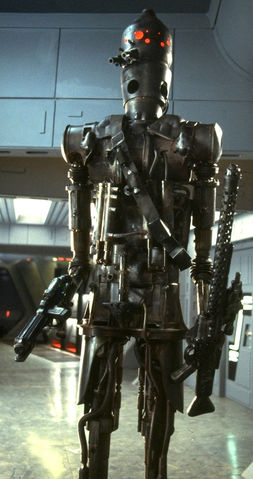
Let’s talk about IG-88. If you’re drawing a blank, he’s the spindly droid bounty hunter seen briefly in The Empire Strikes Back. In the short-story compilation Tales of the Bounty Hunters, we find out that IG-88 was actually one sociopathic droid consciousness spread across four different functionally-identical bodies. His goal? Nothing less than total droid domination of the galaxy.
Anyway, while on board the Executor in ESB, IG-88 hacked into top-secret Imperial files and discovered the existence of the second Death Star. Boy, he thought, that thing would sure be helpful for my droid revolution!
So naturally, IG-88 hijacked the shipment bearing the Death Star’s central computer, and downloaded his consciousness (the last instance of it, as the other three bodies had been destroyed by then) into the computer. It was eventually installed in the station, and IG-88 assumed total control of the Death Star, with the Empire none the wiser. He went so far as to tweak the accuracy of the station’s gunners when firing the superlaser at the Rebel fleet, and was preparing to signal his droid minions to unleash hell on the galaxy with a sentient Death Star as their leader when the station was destroyed…and thank god for that.
Naturally, not everyone is eager to take this story at face value, and it’s never really been mentioned since. Personally, I like to think that the Empire knew exactly what was going on, and had the ability to block IG-88 from assuming total control of the station, but someone figured that as long as he was improving their firing accuracy, they might as well run with it.
My fellow ETE writer and friend across the pond, Ben Crofts, recently wrote a fantastic article praising the Empire’s iconic and menacing Star Destroyers. The Star Destroyer certainly is famous and its place in the opening scene of A New Hope has forever secured its place in cinematic history, but there is a lovelier belle at the ball. She has curves where it counts and it is the best damned looking warship in the Original Trilogy. Who is this lovely lady, you ask?
The Mon Calamari Star Cruiser.
Move over, Star Destroyer, ’cause this gal can catch more second glances than a Twi’lek dancer in Jabba’s palace. No longer are Rebel forces stuck going into battle in rusty old blockade runners or secondhand frigates. They need not be self-conscious of their 20 year old Y-wings or repurposed Separatist ships. Now, for the first time, they have a capital ship capable of going toe to toe with the Empire’s Star Destroyers.
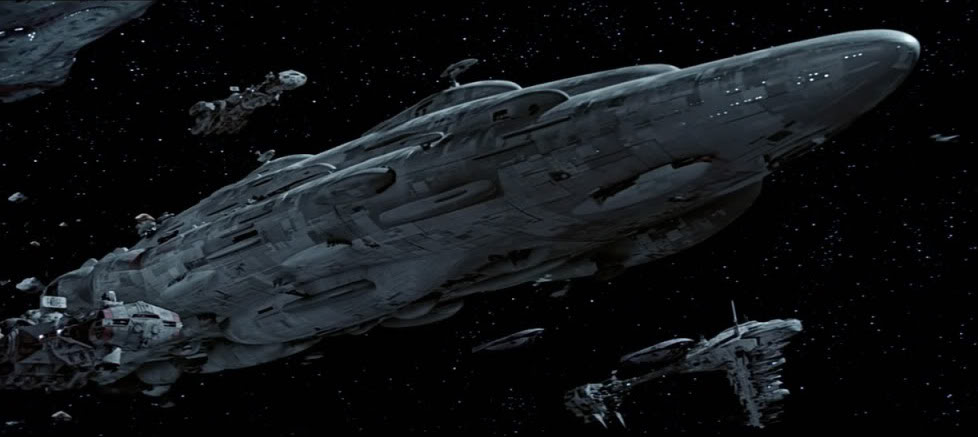
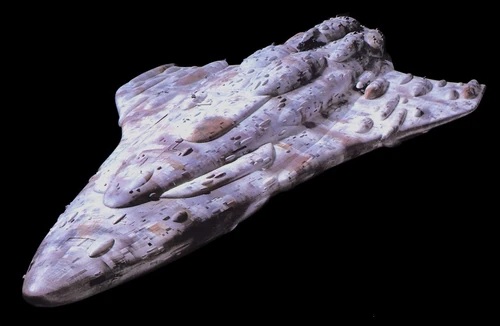
Surely, you say to yourself, Nick must be speaking in jest. No friends, I am being honest. The Mon Cal cruiser is the bee’s knees. Just look at the two primary exemplars of their class, the cylindrical Home One and the winged Liberty. With her graceful lines, bluish hull, and powerful curves, Home One and her sister ships served the Alliance well and helped deliver the knockout blow that put down Vader’s Super Star Destroyer at Endor. The Liberty and her sexy, carefree winged hull form was
designed, so I am told by retired Mon Cal engineers, to lull Imperials into a false sense of security, only to fall prey to her deadly wiles. So scared was the Emperor of these winged wonders that he took a break from taunting Luke to tell the Death Star’s commanders to take her out, lest his forces surrender immediately!
Alright, I have had my fun at the expense of those boring Kuati wedge ships. Backbone of the Alliance Navy and pride of the Mon Calamari, the Mon Cal cruiser is the culmination, from a visual standpoint, of all the progress and growth that the Rebellion made from its early victory at Yavin to the climactic space battle over the forest moon of Endor. When fans were introduced to the Rebels in ANH, they had a handful of snubfighters to throw against the Empire’s mighty Death Star. By the end of The Empire Strikes Back, the Rebel Fleet is depicted as collection of transports, smaller craft, and a Rebel cruiser converted into a Medical Frigate. After the loss of Hoth, the last shot we see of the Rebellion is a ragtag bunch of freedom fighters hiding at the edge of the galaxy. All seemed lost.
Enter Return of the Jedi and the best damned fleet shot in the entire movie. Fans, just getting over learning that Leia is Luke’s sister and listening to Obi-wan warn Like about the powers of the Empire, are treated to an awe-inspiring and majestic shot.
The Rebel Fleet, led by the impressive bulk of Home One, flagship of Admiral Ackbar. As the massive Star Cruiser glides across the screen from left to right, tiny X-wings dart across the screen, while other assorted Rebel warships flank the admiral’s cruiser. For the first time in three movies, the Rebels are shown to have the firepower needed to tackle the Imperial fleet head on. They will have their work cut out for them, they will suffer some significant losses, but ultimately the Rebels and their Star Cruisers will beat the Empire’s best and go on to lead the charge in liberating the galaxy.
Ultimately, the question of whether the Mon Cal cruiser is better or worse than the Star Destroyer is a discussion that Fleet Junkies around the world have debated (and no doubt will continue to) for decades. Some will agree with me, others disagree, and yet others will say that the curvy cruisers and their wedge shaped opponents are actually like peas & carrots, best when served together.
Well, I like carrots. Wait, or is it peas? Crap, did I leave my dinner on the stove?
One thing is certain. When Episode VII comes out, I can guarantee you that one of the many awesome ships we see introduced will be the successors to the Mon Cal cruiser. And who knows, maybe even one of those wedge ships too…

 Vector Prime – The book with one simple message: Chewbacca’s dead, Mara’s deathly ill, and incredibly dangerous biotech-wielding Forceless aliens are invading the galaxy — DEAL WITH IT. –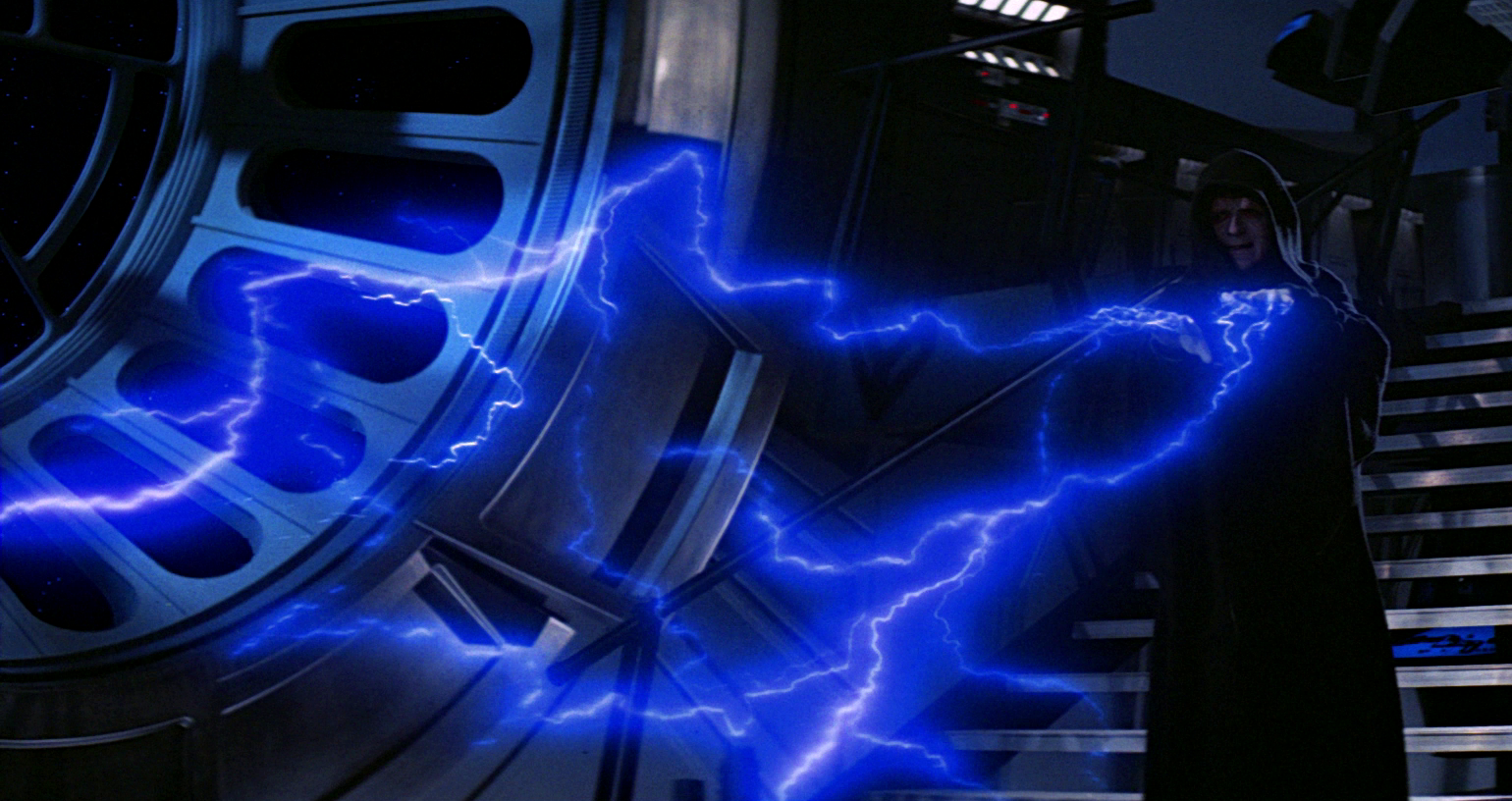
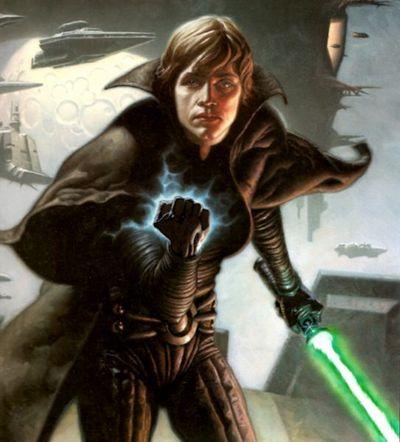 Now then—we actually have a decent roadmap for the first scenario (Luke goes dark and kills Vader) in the comic series Dark Empire, wherein the Emperor comes back in a cloned body and Luke does indeed become his apprentice for a short time. Luke is still genuinely a different kinda dude from his father, though—rather than “falling” for the selfish reason of trying to save a loved one, Luke turns with the intention of studying the Dark Side so that he can better understand why Vader did the things he did, and so he can ultimately defeat the Emperor more completely. It’s still pretty shaky as justifications go, but it at least suggests that he wouldn’t have been quite as docile an apprentice as Vader was—and without Vader’s injuries, he would quickly have become powerful enough to indeed destroy Palpatine…just in time to take his place and be all evil and omnipotent and stuff.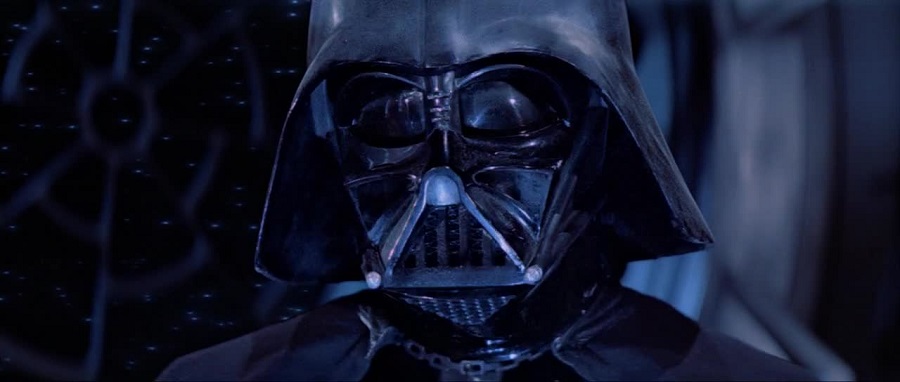
 carefree winged hull form was