![Star_Wars_Propaganda_New_Cover[1]](http://eleven-thirtyeight.com/wp-content/uploads/2016/10/Star_Wars_Propaganda_New_Cover1-337x450.jpg) (Programming note: this piece is the first of three about Star Wars Propaganda. On Friday and next Monday, I’ll be posting a two-part interview with the author, Pablo Hidalgo.)
(Programming note: this piece is the first of three about Star Wars Propaganda. On Friday and next Monday, I’ll be posting a two-part interview with the author, Pablo Hidalgo.)
Like a lot of people, I’ve been looking forward to the Star Wars Propaganda book ever since it was announced. WWII-esque propaganda posters for the Empire and Rebellion have been a part of Star Wars merchandise (and fan creation) for a long time, because they just fit into the old-timey milieu of Star Wars. There’s a certain sense of familiarity to the Star Wars setting – that despite the space opera dressing, the galaxy far far away actually feels rather like ours. Star Wars echoes our history, myth, and fairy tales. And while fairy tales and myth may seem different from familiar history, it’s the myth-making of propaganda that makes the World Wars (or the nostalgic ad campaigns of the 1950s) seem like cultural touchstones as familiar to us as the stories we grew up with.
Star Wars Propaganda is written by Pablo Hidalgo, and is illustrated through the efforts of artists gathered by Becker & Mayer, and is published by Harper Design. But after the publishing pages, everything about the book treats it as if it’s an art history treatise written inside the Star Wars galaxy. See, the central conceit of the book is that it’s written in-universe and all the propaganda posters seen within it are actual pieces composed by actual in-universe artists (even the captions for the pictures refer only to these fictitious propagandists and/or sponsors). The book’s notional author, Janyor of Bith, is a propagandist whose career saw him through an era of patriotic Republic and Imperial paintings to protest paintings on behalf of the Rebel Alliance and the Resistance (it’s worth pointing out that Janyor was mentioned as an artistic inspiration for Star Wars Rebels’ artist-provocateur Sabine Wren in the episode “Idiot’s Array”). The in-universe storytelling is my favorite conceit of this book, because it allows Star Wars Propaganda to weave together the body text and art into a work of storytelling in its own right: telling the story of propaganda, galactic politics, and even of Janyor’s own personal journey in a way that’s more fun and compelling than out of universe narration might have been.
The book begins with an introduction by Janyor, where he states that propaganda is a true form of art, and that art and war are tied together in the same way that politics are tied with war. He’s discussing a fictitious universe, but the observations he makes ring true to life. The book’s about Star Wars propaganda, and the history is the history of that galaxy – but it echoes our own history and myth. The artwork illustrates that story in a literal sense, but it tells its own story through the evolving art styles and subject matter. Someone could get the whole story of the book focusing on the art alone or the text alone, should any such reader be inclined. The art and text help make the setting feel more genuine and lived in; it’s a verisimilitude that the films and television shows have which helps the world the characters inhabit feel more real.
![9781484705667[1]](http://eleven-thirtyeight.com/wp-content/uploads/2016/10/97814847056671-298x450.jpg) The chatter around Ahsoka has been very interesting, and expectations are high for a novel about a popular character who exited two TV series with fans clamoring for more. We’ve seen folks wonder if the novel will bridge the whole 15 years between The Clone Wars and Star Wars Rebels, or whether the novel will address issues like Ahsoka’s romantic inclinations or position on the Force’s duality (or lack thereof). Folks have wondered whether the novel would revive yet-to-be-made episode arcs from the cancelled TCW. We’ve even seen people wondering if Ahsoka will have something for readers uninterested in Ahsoka as a character. These are interesting questions and interesting expectations, but they’re to be expected when the star of the novel is no less a figure than the apprentice of Anakin Skywalker and a survivor of a galaxy-shattering conflict. Folks might come to expect a story on as large a canvas as The Clone Wars, with stakes just as high. That’s what the character Ahsoka deserves, right?
The chatter around Ahsoka has been very interesting, and expectations are high for a novel about a popular character who exited two TV series with fans clamoring for more. We’ve seen folks wonder if the novel will bridge the whole 15 years between The Clone Wars and Star Wars Rebels, or whether the novel will address issues like Ahsoka’s romantic inclinations or position on the Force’s duality (or lack thereof). Folks have wondered whether the novel would revive yet-to-be-made episode arcs from the cancelled TCW. We’ve even seen people wondering if Ahsoka will have something for readers uninterested in Ahsoka as a character. These are interesting questions and interesting expectations, but they’re to be expected when the star of the novel is no less a figure than the apprentice of Anakin Skywalker and a survivor of a galaxy-shattering conflict. Folks might come to expect a story on as large a canvas as The Clone Wars, with stakes just as high. That’s what the character Ahsoka deserves, right?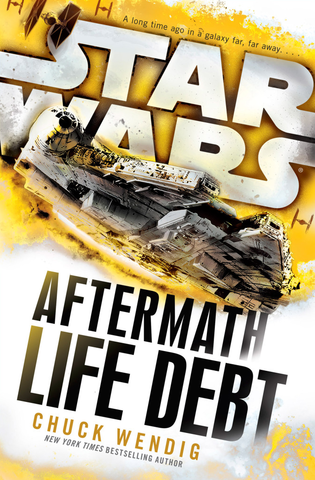 We’re so excited to write about Life Debt that we’re doing so on our phone, since we’re currently away from our computer for a couple weeks. Oh and fair warning, there will be spoilers after the cut – we won’t spoil the end or plot beats, but we will discuss characters.
![The-Force-Awakens-Frame[1]](http://eleven-thirtyeight.com/wp-content/uploads/2015/12/The-Force-Awakens-Frame1-1024x426.jpg) (needless to say, spoilers for The Force Awakens ensue)
(needless to say, spoilers for The Force Awakens ensue)