Top Shelf: The Han Solo Trilogy

Ann C. Crispin

Many of you may have heard the sad news that Ann C. Crispin passed away of cancer at age sixty-three last week. One of the small comforts when an author passes is that she will be able to live on through her writing. To Star Wars fans, that means The Han Solo Trilogy, her main work in the universe. I don’t feel qualified to offer a eulogy to Crispin, who had an extensive career in the science fiction and fantasy community, but I can pay tribute to her Star Wars books, which were among the first I read as a boy stepping into the Expanded Universe.

Crispin’s Han Solo Trilogy is one of the great achievements of the Bantam era. It’s unique in being the only story designed to be a more-or-less complete backstory of a major film hero. A side benefit of this, at least for someone with my taste for synthesis, is that the HST is one of the first major works of EU continuity synthesis, drawing from all over to build a story on what had gone before. Crispin draws characters, backstory, and details of the setting from The Han Solo Adventures; the Thrawn trilogy; The Jedi Academy Trilogy; the Marvel comics; Darksaber; The Corellian Trilogy; Shadows of the Empire; the X-wing books and comics; The Lando Calrissian Adventures; The New Rebellion; I, Jedi; The Crystal Star; the Glove of Darth Vader series; and Dark Empire — and that’s just off the top of my head — and weaves them together into a powerful story that stands on its own merits as an examination of Han Solo’s character, a chronicle of his adventures, and a record of his maturation via a rich character arc. It’s quite an accomplishment. Crispin’s writing is mature, dealing with relationships, death, addiction, and depression honestly and seriously, but it never loses the sense of hope and adventure that distinguishes Star Wars. The books are rich but fun.

The Paradise Snare
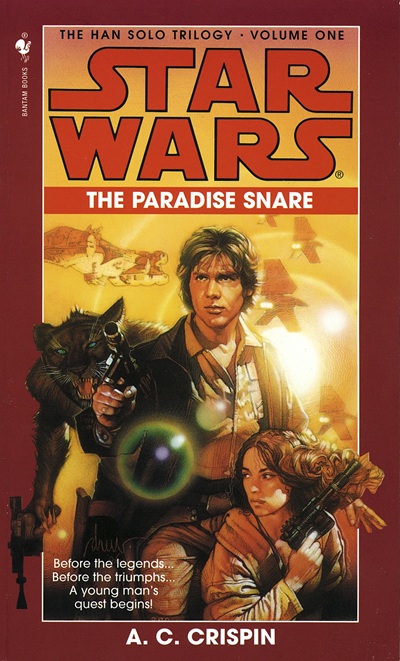
The Paradise Snare

The first book of the trilogy, The Paradise Snare opens with Han’s escape from the cruel con artist Garris Shrike, who, Fagin-like, runs a gang of child thieves and grifters. Han’s past with Shrike is established via backstory, but the novel focuses on nineteen-year-old Han’s efforts to define himself as a man outside the stifling, repressive confines of Shrike’s custody.

Han strikes out to get a job as a pilot on Ylesia, a religious colony, in order to earn enough money to accomplish his real dream: gaining admittance to the Imperial Academy. A mixture of streetwise and naive, young Han grows through his partnership with his copilot Muuurgh, his budding romance with the young religious pilgrim Bria Tharen, and his growing realization that Ylesia is not a peaceful paradise, but something far more sinister.

The climax of the book is astonishing, putting the young, still-idealistic Han through triumph and all-too-real heartbreak. Crispin brings great emotional depth and realism to Han’s story and takes on the issue of addiction head-on, growing Han as a character — something all too rare with the major protagonists — and giving the reader tons of space adventure. It definitely makes the most of its position as Han’s origin story.

The Hutt Gambit

Skipping past Han’s time in the Imperial Navy, The Hutt Gambit opens with a depressed Han mourning the death of his dream, kicked out of the Fleet and blackballed from legitimate shipping jobs. His idealism crushed by the ugliness of the Empire and his dashed hopes, he retreats into the cynical shell we see in the films, reluctantly taking on Chewbacca as a partner.
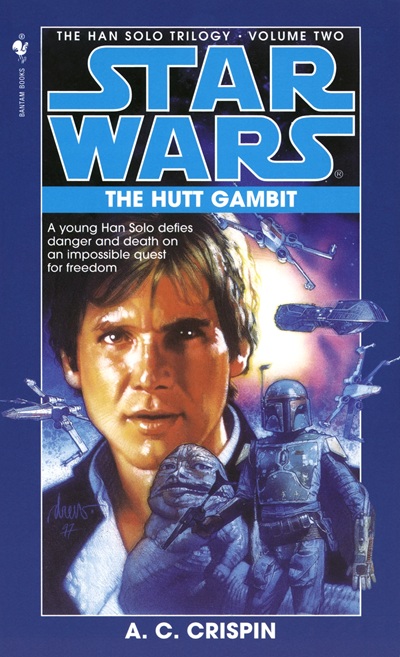
The Hutt Gambit

Just as The Paradise Snare was the story of Han’s maturation, this is the story of Han’s recovery of hope as he takes back control of his life, is drawn into the criminal underworld, and finds success there. Crispin deftly draws from all kinds of sources to build a portrait of Han’s early career as he takes on smuggling jobs for the Hutts and establishes himself in the smuggling communities of Nar Shaddaa and Smuggler’s Run. His friendships with Chewbacca and Lando Calrissian blossom, he is introduced to the Millennium Falcon, and he begins working for Jabba.

The deadly criminal politics of the Hutt clans provide a meaty background for the action, into which Crispin delves with aplomb. The machinations of the rival Desilijic and Besadii clans underlie the trilogy, while tensions between the Hutts and the Empire lead to the book’s climax, in which Han and his Academy-dropout friend Mako Spince organize the smugglers and pirates of Nar Shaddaa into a defensive force that repels an Imperial strike that includes Soontir Fel. Han’s role as a military leader is an excellent example of the way Crispin foreshadows his inevitable development as a hero and his inherent nobility under the cynical exterior masking his emotional wounds without becoming too heavy-handed.

Rebel Dawn
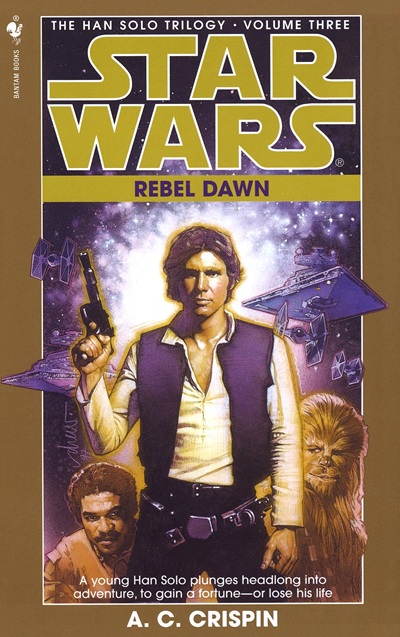
Rebel Dawn

In Rebel Dawn, the narrative continues to follow Han as he wins the Millennium Falcon from Lando. He ends up taking a jaunt away from Nar Shaddaa, allowing Crispin to excellently integrate Brian Daley’s venerable Han Solo Adventures (themselves the certain subjects of a future Top Shelf), while the other characters around Han take over the narrative briefly. The Shakespearean machinations of the rival Hutt families remain riveting, while Bria gives the reader entry into the early days of the Rebel Alliance.

When Han returns to Nar Shaddaa, Bria draws him into a Rebel plan to raid Ylesia. Betrayal ensues, and between that and the failed spice run that puts him in debt to Jabba, we see Han increasingly alienated and angry, moved into place for A New Hope.

These three novels are examples of the Expanded Universe at its best. Not just for Crispin’s masterful synthesis of sources, but for their emphasis on mature character development, exciting adventure, and classic universe-building that turns the underworld and Hutt elements of the universe into a vibrant, vital setting. They not only develop a rich and endearing portrait of Han, but give Chewbacca and Lando more respect and development as characters than almost any other EU work. The Han Solo Trilogy is among the very best that the EU has to offer, and it is a great pity that I have to speak of it in the context of Ann Crispin’s death. Though she has passed on, it is a great comfort to her fans that she left behind such excellent and enduring work by which we can remember her.
On Ultimate Star Wars—Implied Canon and the Foggy Window

“I always like the smaller, more personal stories best. Because the movies contain so much big action and so many galactic threats, a lot of writers want to replicate that in the comics and fiction. Unfortunately, because the stories are almost all considered ‘canon,’ it means that the Star Wars galaxy is subjected to a constant stream of dire threats. To me, it strains credibility. I’d much rather see a smaller story, the events of which are important to just one or two characters. I say, leave the big stuff to the films.”Randy Stradley, 2002

Let’s get this out of the way: nothing can save post-Return of the Jedi continuity but Michael Arndt. I, honestly, see no reason just yet to make any assumptions on that matter. This article is primarily a thought exercise, and for the purposes of such I will indeed be assuming a scorched-earth scenario—no Mara, no Jacen or Jaina, even a totally different resolution of the Galactic Civil War—but the points I intend to make will stand no matter what actually comes to pass.

I describe this scenario as “Ultimate Star Wars” for a reason—but not, actually, to suggest a full continuity reboot; I believe a number of lessons can be learned from the example of Marvel Comics’ Ultimate universe (a modern reimagining of their primary continuity’s origins) without going quite that far.

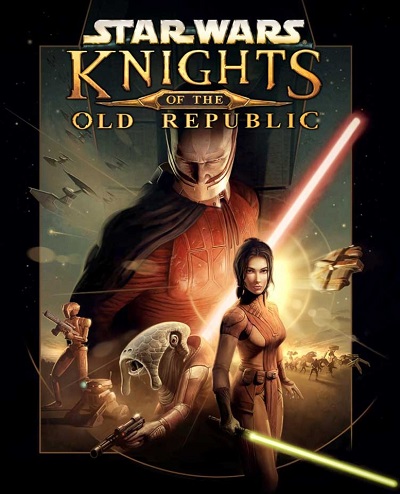
kotorgamecoverFor starters, consider the Knights of the Old Republic video game. Not only is its popularity unrivaled among Expanded Universe stories, with the possible exception of the Thrawn trilogy, but the thing is a giant, hulking brick of story plopped right into the middle of what was previously a fairly empty span of time—it certainly owed a lot of groundwork to the Tales of the Jedi comics of the nineties, but I think few would argue that it didn’t run a good bit farther with the ball than Anderson and Veitch ever did.
So now that we’re all on the same page…try to envision a scenario where KOTOR had to be thrown out of continuity. Not retconned, but totally thrown out; to the extent that Legacy of the Force would be if Jacen Solo were erased from history. Read More

Firing the Canon: It’s the Caliber that Matters

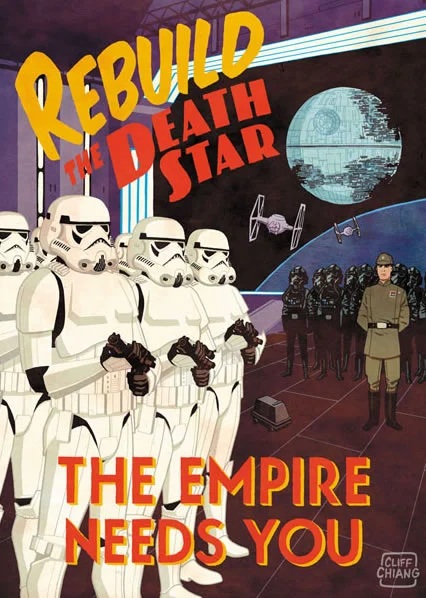
Ever played a Star Wars video game and wondered how much of it was a “real” part of the Star Wars universe? Ever picked up a lunch box or a coloring book and thought to yourself whether or not this was part of the Star Wars mythos? For most people it’s unlikely, although for readers of this blog it’s a distinct possibility. Today we examine whether most everything with a Star Wars label on it should be part of the Star Wars continuity – or canon – or whether some products should exist just for the sake of fun and enjoyment, without complicating things unduly.

At the start, we’ll note that we’re not arguing for film purism. We’re not even arguing for snobbery that suggests a certain time period of Expanded Universe products was written better than others, which should be written out of the universe. In fact: we submit that the widely varied, inclusive, and richly textured Star Wars canon is what gives the Star Wars universe its scale, life, and energy. Instead, we want to focus our analysis on two specific recent Star Wars endeavors: The Force Unleashed video game and the Star Tours: The Adventures Continue attraction at the Disney theme parks. The question is: should these be an official part of the Star Wars canon, or can a ride be a ride and a game be a game sometimes?

**********Needless to say, this essay will contain spoilers for both the video game and the amusement park attraction**************

Canon – why all the sound and fury?

Canon – the term is redolent of literary and religious prestige. The canon, according to the Greeks and the Romans, was the body of literary work that was held in the highest esteem by the great and the learned: what we might today call classics or great works. To religious authorities, the canon is the list of books that can be deemed authoritative within religious dogma, and canon law is therefore the law set down by the Church since late antiquity. Both definitions derive from the original Greek word κανων, which was basically their word for a “yardstick” – later, a standard by which to judge other things.

Fictional franchises, including Star Wars, have adapted this usage: a canon work is a work within a franchise that is part of the official storyline. It is often distinguished from apocrypha – another term with religious roots – which refers to works which may share the same fictitious universe, but are not part of the official storyline or world that the creators have constructed. For the longest time, Star Wars fans debated whether anything that wasn’t a Star Wars film could ever be part of the authentic, canonical Star Wars saga.  Debate raged on among the fans, who clung to off-hand remarks and scattered quotes from George Lucas and Lucasfilm representatives over the difference between “canonical” and “licensed,” “official” or “alternate universe.” Eventually Lucasfilm Licensing settled the issue, creating a tiered system for canon. The system, as it stands today, refers to the highest level of filmic canon as G-canon, The Clone Wars television show as T-canon, the Expanded Universe of books, guides, and games as C-canon, obscure and sometimes contradictory material that might gain canon status by reference in other works as S-canon, and works that aren’t canon at all are called N-canon (or by a prior name, Infinities).

So why this complex scheme? Well, it’s a concession to the idea that the Lucas-created world has primacy and that spin-off materials might sometimes conflict with it (though usually it’s the other way around, such as when the Prequel films contradicted some of the material established in the older EU). This canonical hierarchy resolved the problem by declaring that EU materials would be displaced by television or filmic materials, although continuity-minded folk will tell you that a hierarchy only solves part of the problem: trying to reduce the damage to the EU continuity by mitigating and massaging potential conflicts through retroactive continuity adjustments is an on-going process.

Moreover, the canon hierarchy does not really solve the problem of conflicts within the Expanded Universe C-canon category. The general rule of thumb is that almost everything is C-canon unless stated otherwise as a higher level of canon, and more recent C-canon sources trump older ones. Here’s where the problem arises. We could have an entire discussion on whether it’s a bad idea to have the most recent source trump older ones, especially as a strict chronological assessment takes no account of quality. But today, we’ll be focusing on the all-inclusive nature of C-canon instead.

The Force Unleashed

The Force Unleashed – hereinafter “TFU” – was a video game with an accompanying multimedia blitz of books, action figures, and RPG materials that resembled the great Shadows of the Empire (“SotE”) project of the late 90s. However, as far as continuity goes, the similarity ends there: where SotE carefully made use of existing continuity to expand and develop the universe, TFU ran roughshod over existing continuity and failed to make a good accounting of itself.

Let’s be specific: we’re talking about two issues. First is the over-powered nature of the main character, and second is the way that TFU changes the story about how the Rebellion was founded.

The main character in TFU is capable of astonishing feats of the Force, as per the game’s title and premise: to showcase Force usage beyond any limits we had previously conceived or witnessed. Consequently, Starkiller can not only blow his enemies away with gale-level Force bursts, crumple reinforced bulkheads as if they were tin soda cans, or wield enough lightning to embarrass both Thor and Zeus, Starkiller can also pull an Imperial Star Destroyer out of the sky while destroying its TIE Fighter escorts – all on his own! Oh, and he can outfight Darth Vader. No big deal.

Additionally, Starkiller – once Lord Vader’s secret apprentice – redeems himself and becomes a good guy because it’s thoroughly necessary for every Star Wars work to completely undermine the mythic saga of Vader’s redemption… whatever! As part of his redemption story, Starkiller inspires Bail Organa to formalize his opposition to the Empire and arranges for him to set up meetings with key resistance leaders to create a movement that will be known as the Rebel Alliance. Now, to the game’s credit, the story does make use of existing continuity on the Rebellion’s foundation by involving three Old Republic Senators – Bail Organa, Mon Mothma, and Garm bel Iblis, but it places Starkiller in the central role. Worse yet, it turns the signing of the Declaration of Rebellion into an Imperial ambush, after which none other than the Galactic Emperor himself – on board the Death Star! – personally beholds the new Rebel leaders. Why is this problematic? Because Bail Organa in particular continued to serve in the Senate, and because the EU had long since established that he was a secret backer of the Rebellion within the Imperial Senate, as contrasted with the rather public retirements of Mothma and bel Iblis.

This is not only an EU problem: it stretches credulity for Princess Leia Organa to be Alderaan’s senator, and shielded by diplomatic immunity if her father is a known traitor. Why did Lord Vader need a pretext to arrest her? Why was her father free to operate as he saw fit?

One last insult to injury: Starkiller’s family crest became the symbol of the Rebel Alliance. Might as well go all the way, we suppose.

There’s an easy solution to all of this: TFU is just a game. Treat it as such. Now, we can hear the cries of all the EU completionists already: they’ll point out that games are a valuable part of the EU canon and have made a lot of important contributions, in terms of storyline, ideas, and even integration of existing continuity. This is all true, and we do not argue that video games are intrinsically non-canon. Yet when the logic of a video game requires immense suspension of disbelief – such as when Empire at War had us believe that Princess Leia’s corvette at the beginning of A New Hope was escorted by a Rebel fleet as it fought with Lord Vader’s Star Destroyer (making one wonder if she thought Lord Vader was mentally compromised to believe her protestations of diplomatic innocence) – one should just say a game is a game.

The premise of TFU was to break boundaries and astonish the audience. It succeeded. But its very goal demands that it just be treated as an imaginative exercise rather than an existing and functional part of the Expanded Universe.

Star Tours: The Adventures Continue

In 1987, George Lucas and Industrial Light & Magic dusted off their old Star Wars models and created the first live-action Star Wars film experience since Return of the Jedi. It was an astonishing feat and it echoes all the rollicking good fun and excitement of the original Star Wars films. It remains this author’s favorite theme park attraction.

Yet the attraction – a short film projected onto a motion simulated space transport – had some continuity wrinkles too. Ostensibly, the Star Tours company operated Starspeeder 3000 transports – providing an amusing Star Wars-ified view of air travel, but in space, complete with airport humor – on tours to familiar locales from the original Star Wars films. The attraction itself featured the “Endor Express,” but the riders never arrive at the planet, instead experiencing a wild ride through ice comets, a close call with an Imperial Star Destroyer, a dog-fight among X-wings and TIE Fighters, and finally an honest-to-goodness Death Star trench run. But wait – which Death Star was this? It had a trench, but it’s at Endor – but it’s fully complete, too! Lucasfilm employees and Star Wars writers have as much fondness of the ride as this author does, so they took great pleasure in referring to a hypothetical Death Star III, effectively treating the ride as canon. Yet there was no pressing need for the ride to be C-canon: an author could express their fondess for the ride by referring to specific aspects of it, such as when Timothy Zahn referred to the “Starspeeder 3000” craft in his Thrawn trilogy of books in the early 90s. The ride could have been S-canon!

Star Tours was recently redone with modern simulators and a 3D, HD video track. Since the ride eventually became “stale” among park attendees over a period of two decades, the new version of the ride featured several alternate scenarios: the odds of any two ride experience being the same were now much smaller. The potential sequences span different worlds, from arboreal Kashyyyk to urban Coruscant. Though the ride is notionally a prequel to the original Star Tours – featuring Starspeeder 1000s – and consequently set between Revenge of the Sith and A New Hope (confirmed by video displays inside the ride waiting area itself), the Coruscant sequence features scenes right out of Episode III’s opening battle while the Hoth sequence features an Imperial attack on a Rebel base complete with AT-AT walkers. Even the Naboo sequence features a Trade Federation attack on the planet, even though the Naboo pilots offer to lead the Starspeeder to the planet’s “Rebel base,” where the passengers are inducted into the Rebel Alliance.

EU continuity buffs enjoy challenges of this nature: they enjoy coming up with convoluted explanations, such as a Clone Wars reenactment above the Imperial capital, or a pirate attack on Naboo using captured Trade Federation ships (admittedly it was enjoyable coming up with those). The question is, though, aside from an intellectual exercise: what do these fixes accomplish? What benefit do they provide to the larger Star Wars universe? Can’t a ride just be a ride?

Recently, Star Wars writer James McFadden published a blog article on the official Star Wars website chronicling, in-universe, the two incarnations of the Star Tours ride. He very deliberately avoided answering the question of whether or not the new Star Tours ride was canon in every aspect, although he did reveal in comments on TheForce.Net’s Literature forum that he favors treating the ride variations as snapshots into different Starspeeder journeys taken by Rebel spies at different chronological periods of the Galactic Civil War. This solution is probably the best solution offered: although we still wonder if perhaps a fun ride or a fun video came can be just that, without requiring so much extra effort just to squeeze it into continuity.

“Humans ARE Superior!” Really?

As far as Farscape, humans really were not superior! Not even close. For Star Wars?  It is considerably hazier but aliens do seem to fall into a number of frequent use categories or roles. Of course, if we go by Imperial propaganda, humans are superior but that was the Empire for you.

Single trait: this tends to crop up frequently, Hutts tend to gangsters, Twi’leks are frequently dodgy, Wookiees are heavy hitters that no one messes with. There are exceptions to this – Aayla Secura for instance for Twi’leks, the recent Dawn of the Jedi: Into The Void also gave us Tre Sana.

Less enlightened: step forward Borsk Fey’Lya and his successor, Pwoe. These two make the case for why aliens can’t run the galaxy – look what happened when they did! The galaxy conquered, Coruscant ravaged, trillions dead. More so than others, they also traded their alien status to gain power, Borsk never missed an opportunity to bring up what the Empire – and by extension – humans had done to the Bothans. Pwoe was inclined to similar gutter politics.

More enlightened: I’m hard pressed to think of many such characters, for all Yoda knows we see him take a serious loss in Revenge of the Sith.  There is the Caamasi character of Elegos Akla, who we see advising Corran Horn both in I, Jedi and the New Jedi Order.  However, the latter story kills him off, so Horn can no longer rely on his advice.

What of equals? There are a few, sure there’s Chewbacca, but he was so little used and deemed so uninteresting that a moon was dropped on him!  What of Gavrisom, who ran the Republic during the Hand of Thrawn books?  He gets frequently compared to Leia, so of course he’s going to lose, but he did just about keep the Republic together and was then never seen again.  Legacy gives us Gar Stazi, even Cade Skywalker could not disrespect this formidable Duros.  He tried certainly, but failed.

What I’m getting at here, for all that aliens feature, it tends to be humans that the galaxy revolves around.  To be fair, however, Star Wars is far from the only offender in this respect.  Star Trek commits the sin numerous times – Klingons, Ferengi, Cardassian, Andorian, Vulcan – they can’t get anywhere without humans.  Babylon 5? The Shadows and Vorlons had a nice once-a-millennium traditional punch-up going on and then those pesky humans poked their nose in and it all had to stop!

It could be asked, for the politics, why is there not an anti-Fey’lya type present? An alien politician who has succeeded not by taking the low road but the high? Would such a character be seen as a threat to Luke, Han and Leia’s moral authority? Even if there was, the accusation could still be made that for all their appearances, alien characters are simply partial reflections of human traits in external form. It’s difficult to refute this because, by its very nature, it is inevitable. The only response is to bring in aliens who are, in every sense, alien in their outlook but these tend to be exceedingly difficult to create. Even when they are set up, the resolution options tend to be separation or co-existence, with the latter being made possible through the identification of some common ground. So, not all that alien after all then.

Perhaps better to ask what characters there are that are deemed as equal to the lead human characters? In this respect, it seems the best examples in recent years can be found in comics. Knights of the Old Republic alone gives us two very well-realized characters in the form of Jarael and Gryph, the latter of which has his own fanbase!  Dark Times has Bomo and the crew of the Uhumele, all well-done characters.  In both cases we don’t see either Zayne Carrick or Jass Dennir attempting to steamroller them into submission, although it isn’t in their character to do so. Stazi, already mentioned, tends to take center stage in any story he’s in and then there’s Jedi Master K’Krukh…
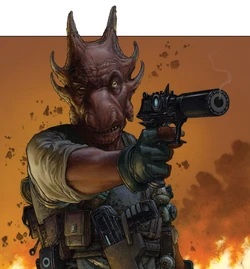
Who has the status of controversy incarnate for some fans. Why? Because he legged it when Order 66 came down, hid out for a few decades, then returned to the revived Jedi Order and was feted as a wise senior Jedi! Nor is this restricted to K’Krukh, as a Neti character, T’ra Saa, also tends to get blasted for similar reasons. And they’re running the Jedi Order in Legacy, opting for a similar strategy to that used by Yoda and Obi-Wan, of waiting the Sith out until the right time. To be fair, the charge tends to be that they didn’t earn the leadership positions they occupy, but a counterpoint to this is that we do not know how they attained those positions.

And there is perhaps the crux of the matter: Should alien characters hold positions of power? About the only popular such character I can think of there is Admiral Ackbar – very popular creation in every respect. Others? There is, of course, Thrawn, until he became all heroic. (Or did he?) There is Saba Setayne, who is often seen as Denning’s pet character much in the way Thrawn is seen as Zahn’s. Surely there should be more? Perhaps this is something Episode VII will attempt to fix. Until then we’re stuck with the current flawed and very limited selection.

Escape Pod: Mara Jade Skywalker

I find myself surprised to be writing this article. Surely if I wanted one thing from the Expanded Universe to survive the anticipated Disney purge and make its way into the Sequel Trilogy that it would be my favorite character, Corran Horn, right? The more I thought about what to write as I sat down to write that article though, the more my appreciation for the character of Mara Jade kept pushing itself into my thoughts. So I’m writing to save Mara Jade instead.

This appreciation was completely unexpected, not only because I thought I was going to write about a different character but because I have never been a big Mara fan. Looking back I realize now that I should have been and I can’t even explain why I wasn’t a fan. She really embodied what I look for in strong female characters in the Star Wars books. I didn’t quite know what I had until she was no longer included in the stories.

Zahn’s Jade

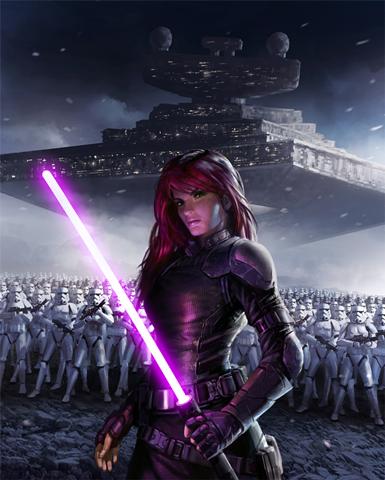
385px-Choices_of_One_PB_artThis Jade is perhaps the one I least like which is weird since he invented the character. Don’t get me wrong, I find the concept of her character to be enticing and I like how despite being the Emperor’s Hand she constantly makes decisions for herself and doesn’t feel like killing is always the answer to a problem. I think as a youngster reading the books I didn’t want to like her because she wanted to kill Luke and no one was taking my hero away from me! However, as an adult reading Zahn’s books now I find myself not liking the situations she’s written into. Zahn created this amazingly strong character and for the most part she is written into books where she can’t really win because Luke, Leia and Han are always in the way. By the time Choices of One came out I was really expecting or hoping to have a book with Mara Jade and without Luke, Han and Leia in it. I actually can’t figure out why all of her stories have to revolve around them. I believe she is a strong enough central character to the EU that she could hold a book by herself. I feel like we’ve never gotten to see her be the ultimate assassin/dark agent because the Big Three are always there to spoil things.

Now you might be thinking that during the timeframe that Zahn writes in Mara is the bad guy. Should the bad guy get to win? Answered simply, yes, if you consider her a true bad guy. I don’t. Time and again we’ve seen her administering Imperial Justice on people who actually deserve it for one reason or another. She’s not ruthlessly killing anyone she encounters and she usually tries to find out the truth before passing judgement. That’s part of what makes her character unique and intriguing to the reader. Therefore I don’t understand why we’ve never had a novel where we solely followed Mara Jade around. She’s the total package of a female character and could definitely hold down a book of her own. She is intelligent, independent and powerful which are all qualities I would like to see in the female Jedi that are included in the Sequel Trilogy. Why invent a new character when the perfect one already exists?

Bantam’s Mara Jade:

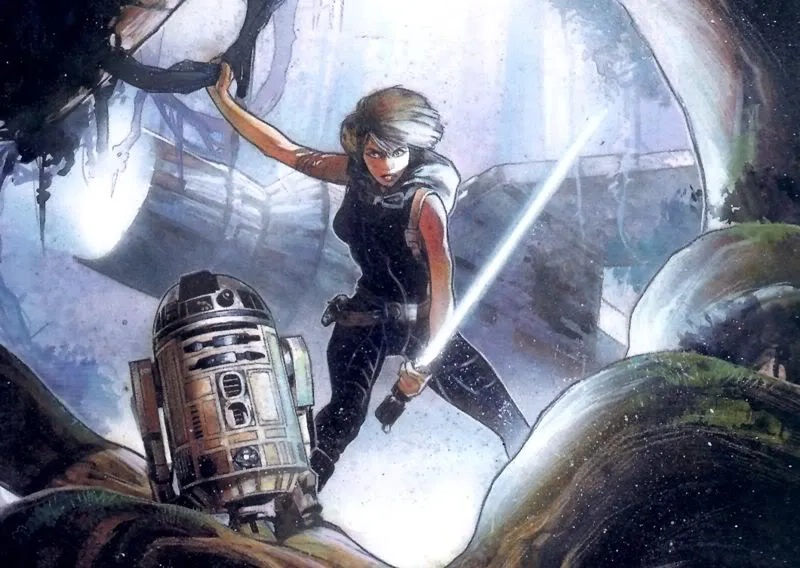
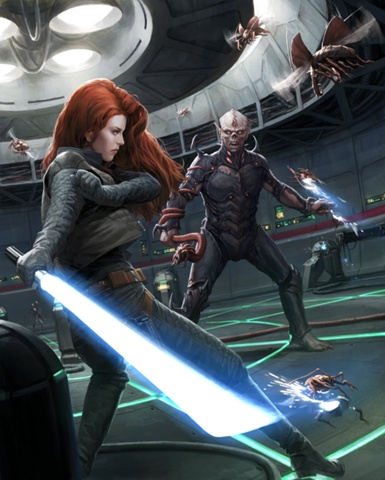
Jade survives the death of the Emperor and becomes successful in Talon Karrde’s organization. This version is definitely my favorite of the Jade character. I like how she decides to train as a Jedi only after a lot of thought and living of life. She continually tries to avoid the attraction to Skywalker and busies herself with the Smuggler’s Alliance and Lando. Her travels keep bringing them together and in a touching scene we finally get Luke admitting his love for her. She challenged him at every meeting and the Mara they developed became the best match for Luke.

385px-Maravsyomin

Del Rey’s Mara:

The only part I enjoyed of this version of Mara was her determination and strength shown on Dantooine during the NJO. Despite her sickness and hordes of Vong attacking them, she was able to stay alive long enough for backup to arrive. The ultimate motherly instinct and I applauded Del Rey for keeping her alive even after Ben was born because I seriously thought they were going to kill her off then. So often storytellers feel the hero needs to be motherless. When Anakin Solo died the readers shifted their focus to Ben and were hoping for great things from the offspring of Luke and Mara.

I am not going to get into the bad parts of the Del Rey Mara Jade and those are definitely something I don’t want to see saved from the purge. I’d also ask that any discussion doesn’t go into that either. I’m interested in having Disney preserve the character that is Mara Jade Skywalker and seeing her with Luke in the Sequel Trilogy (while also being a badass female Jedi too!).

480px-Mara_Jade_SWGTCG

Final Thoughts:

Mara Jade is the perfect match for Luke Skywalker. If they are going to have the story call for an offspring of Skywalker, and it seems logical that it would, I sincerely hope they include Mara as a female role model for the young Jedi in the series and as a wife and mother. Mara Jade has been a part of the Expanded Universe for a long time as a strong female character. I’m also slightly tired of heroes always having a missing or dead parent(s) in movies. So many of the recent sci-fi/fantasy stories seem to start with dead parents and I don’t think it is always necessary. I know some of this contradicts my thoughts on how Luke is going to die in Episode VII but I have been persuaded by some of the comments made on that article that the death of the mentor has been overdone. Star Wars also has a track record for having missing parents ie. Luke initially had no parents and Anakin’s father was unknown and then his mother was killed off in Episode II. If they can find a plausible way for Luke and Mara to remain together alive and on the sidelines I am all for them staying that way but I don’t want to see it at the expense of not fully developing the next generation of Jedi. Mara Jade is a great example of a female Jedi and I hope that they decide to include her in the Sequel Trilogy and other stories.