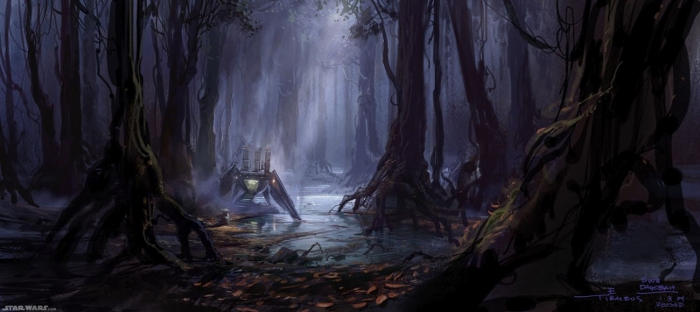
13. How did Obi-Wan know where Yoda was?
First, some background.
Dagobah, while not being at all noteworthy in a political sense, is a fairly noteworthy planet as far as the Force is concerned. It was “discovered” and subsequently forgotten multiple times over the years, and one survey team actually found that life there was abnormally ripe for genetic and medicinal research (remeber Luke’s “massive life form readings”?). Likewise, one of the reasons Yoda chose to hide there was because it was so choked with myriad other life forms that his own Force presence would be largely subsumed and harder to detect. Whether the strong Force signature caused the biological potency or vice-versa is pretty much a “chicken v. egg” situation, so it’s easier to just look at Dagobah as the Amazon rain forest of the Star Wars galaxy—teeming not just with life, but with an abnormal variety of life with abornally unique properties.
One thing that tends to bug hardcore Expanded Universe fans is the unusual amount of important events and/or people on Tatooine—a planet that’s very explicitly stated to be the ass end of space, but is constantly revisited due to its iconic status. Dagobah has a similar problem, relatively speaking, but its role as a major waypoint in the Force-User’s Guide to the Galaxy is, as I’ve discussed before, the ultimate get-out-of-jail-free card where coincidental arrivals are concerned. As such, there are a couple options for the origin of the dark-side cave, but the most likely candidate these days is a duel between an errant unnamed Dark Jedi Master and the Jedi Knight Minch—who was sort of a wink-wink, nod-nod stand in for a younger Yoda himself—in 700 BBY. The Dark Jedi was killed, leaving a stain on that location around which the cave eventually evolved. The origin of this story was a reference all the way back in Heir to the Empire to Yoda killing a Dark Jedi there; Lucas gospel, however, maintains that Yoda had never been to Dagobah prior to Revenge of the Sith, hence the stand-in. The death of a major dark-sider leaving a mark like that is pretty standard fare; in fact, one of the more creative fan theories going around in the early days of the prequels was that Naboo would somehow become Dagobah, and the cave was the spot where Darth Maul had died.
Read More
 As you’ve likely heard by now, longtime Star Wars author Aaron Allston passed away suddenly yesterday after collapsing at VisionCon in Branson, Missouri. The news came late last night and threw us all for a bit of a loop, so we’ll be taking an extra day off to collect our thoughts, and we’ll be back with those on Monday.
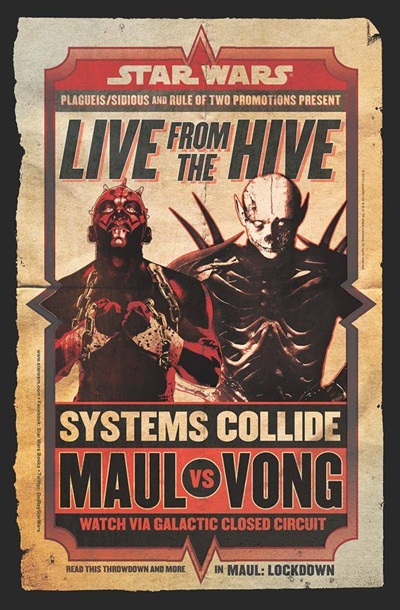 In last week’s new release Maul: Lockdown, Darth Maul is sent to uncover a reclusive and mysterious arms dealer hiding out in Cog Hive Seven, a space-based prison whose architecture is infinitely rearrangeable. This has two benefits: one, escape is much more complicated when the route out of your cell is constantly changing, and two, it allows Warden Sadiki Blirr to pick any two inmates and smack them together like action figures. The resulting deathmatches are then broadcast to the galaxy for gambling purposes, with Blirr herself collecting a healthy piece of the profits. This system of near-constant combat makes up the spine of Lockdown‘s bloody proceedings, and while the Rubix-Cube-like concept of Cog Hive Seven is a novel approach, the general premise of gladiatorial combat has a long and storied history in the Galaxy Far, Far Away, dating almost all the way to the beginning of the Expanded Universe.