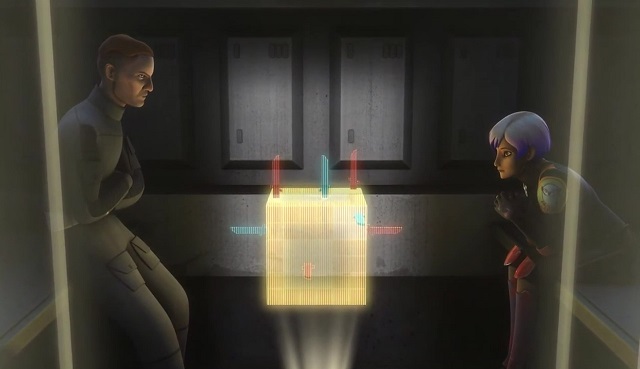
Rebels Revisited: “You Have Stayed True to Our Ideals” – Sabine and Mandalorian Culture

rr-sabine-cubikahd

Mandalorian culture has been a rather interesting topic of discussion for quite a while now, pretty much since Boba Fett first walked onto people’s screens, and the idea was seeded that he came from a culture of warriors dressed in similar armor. It’s been teased, fleshed out, then rolled back and retconned and fleshed out again several times, from the pre-prequel era in Boba’s early Expanded Universe exploits, through the prequels with Jango Fett’s backstory and Karen Traviss’s books, then in The Clone Wars, and now in Rebels.

Back in TCW, most of the slate was wiped clean, with the idea that Mandalore had been taken over by a largely pacifistic faction and their warrior culture was frowned upon and shunned. The few warriors who stuck around were labeled terrorists, siding with the Death Watch. Then Obi-Wan got involved, Darth Maul arrived, and things started to go downhill very quickly. By the end of what we’ve seen (with the fabled “Siege of Mandalore” being largely unknown) Mandalore has been torn to shreds by civil war, with Duchess Satine and her faction being all but wiped out and two factions of the Death Watch battling for control of the capital.

Since then, Rebels has been trickling out the details about what Mandalore is like in bits and pieces. Sabine mentioned in the first season that she had attended the Imperial Academy there, and in the second season we were introduced to Fenn Rau and his Protectors, a faction of soldiers acting as police of a hyperspace lane. They value honor, respect the strong, and strike an alliance with the Rebels while still nominally serving the Empire in an attempt to maintain their independence from either faction. We also got our first clues of exactly who Sabine Wren is, in that her family is said to be loyal to clan Vizsla, the same clan as the leaders of the Death Watch. Read More
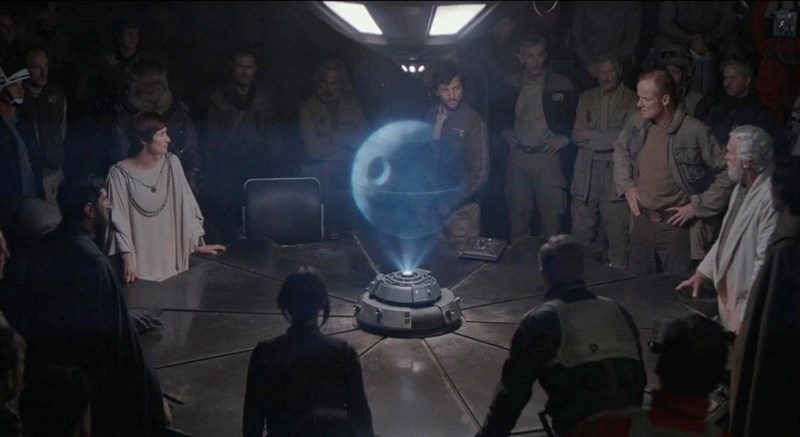
Rogue Discussions: The Story Trailers of Rogue One

rogueone-ds-holo

A while back, we did a discussion article on the initial teaser trailer for Rogue One. Now with the full story trailers unveiled, it’s time for a sequel as we adjust to two trailers, combining to be about five minutes, packed full of awesome imagery.

Part 1: The Death of Imperial Cool?

Ben: One thing that occurred to me watching the trailers is that this could well be the first real depiction of what the original trilogy only hinted at – life under Imperial rule. It might be said Rebels got a bit closer to that in its first series when Tarkin turned up, but by its target audience, it could only go so far. This film can go much further. The sense I get from the story trailers is the Empire slowly crushing the life out of the galaxy. It is quite simply dominating it into submission and the ultimate tool of that is the Death Star.

One thing the new material appears to have aimed at from the start is rendering the Empire both as more seductive, but also more brutal and far more irredeemable than its Legends counterpart. At the same time, Star Wars has always had a tendency to give its villains the best toys. Sure, the Rebels have their X-wings and the Falcon, but the Empire gets the Star Destroyers, TIEs and walkers. Divorced from what it is actually about, the Imperial aesthetic is designed to be both cool and intimidating – it sends an attractive message: Join us and you get to wear this and use these things.

What I wonder is if Rogue One will blow a large hole in this aesthetic of Imperial Cool by showing in far greater detail what the Empire is really about. Nowhere is that more emphasized in the trailer than in the way it goes about depicting the Death Star: so massive that just its laser dish eclipses Star Destroyers, while the thing itself can blot out the sun. There’s no explanation or justification for the Death Star, it is a form of technological malice without restraint. So in the wake of that, is the Empire still cool? Or are all its tricks to sucker people in revealed as the work of an insatiable predator? Read More

Controlling the Narrative — A Discussion with Pablo Hidalgo, cont’d

Star-Wars-Propaganda-Poster-Set_Page_06[1]Today we conclude our week of Star Wars Propaganda coverage with the second part of our interview with author Pablo Hidalgo. This piece is a continuation of last Friday’s interview segment, where we discussed the development of the Propaganda book and how both it and its art was commissioned. Last Wednesday, I shared my own thoughts about the Propaganda book, particularly enthusing over how it used art and narrative to create an open and accessible form of world-building that enhanced storytelling seen in the Star Wars movies and novels. Appropriately, this second part of our conversation with Pablo focuses on narrative and in-universe storytelling.

My questions below are in bold, and Pablo’s answers are in plaintext.


Speaking of the in-universe work already done – one of my favorite parts of this book that it’s in-universe. I like in-universe work in general, whether it be travel posters or propaganda posters. How did it help in writing this book for it to be in-universe? You could have just as easily written it as an out-of-universe book like the Visual Dictionary. How does being in-universe help and what guided that decision?

For one thing, it’s more fun because I get to play a character, rather than my usual character of the omniscient third-person narrator. By playing a character – I don’t really do a lot of fiction, though, this book is technically classified as non-fiction. It is a work of fiction though, because this book is describing a fictional space in the way that it does. So as a result, I don’t get to do a lot of character work in the material that ends up being published. So this is my chance to be a character, which is fun. The thing that it [does] is that it allows you to play with point of view, and it gives you a stronger ability to editorialize and duck out of conversations that you may not be ready to talk about. An example is, if I was going to tell you the history of any country—if I was going to tell you the history of the U.S.—I would edit that to tell you what I thought was important for you to hear. But sometimes when it comes to telling histories of fictional universes, there’s this weird burden to tell you everything. That would be the equivalent of me telling you the history of the U.S. and starting with, “When the Earth cooled, the landmasses distributed themselves…” but you don’t need that information. As a result, an in-universe narrator can take for granted what you as an in-universe reader should already know. And the funny thing is, those are things that maybe haven’t been defined, such as the origins of certain institutions and the origins of certain parts of history. But I can avoid getting into that detail because presumably you already know that even though outside that universe [you] don’t.

Read More

Behind the Propaganda — A Discussion with Pablo Hidalgo

Star-Wars-Propaganda-Poster-Set_Page_05[1]On Wednesday, I shared my thoughts on how the Star Wars Propaganda book made wonderful use of the medium of an art book to tell a worldbuilding story about the Star Wars galaxy that was grounded in a sense of familiarity for the audience.  I discussed how the in-universe method of storytelling worked well to discuss the subject of propaganda, and noted that the book was just plain fun. Since I liked the book so much, I wanted to talk to the author about how the book came together and what ideas went into putting the book in its final form.

Here’s Part One of my interview with Star Wars Propaganda author Pablo Hidalgo; join us Monday for Part Two. My questions are in bold, and his responses are in plaintext (except for anything inside brackets).


How did propaganda become one of the first subjects for a reference book in the new Star Wars canon? The book contains art and propaganda, but also narrative – in what ways is this a better (or just different) starting point than a more traditional Essential Guide type of book?  

The idea of a propaganda book crossed my desk as a fully-formed idea. I’m not sure who originated it, but I first heard of it from my editor Delia Greve, who’s at Becker & Mayer (the company that packaged the book). Before she was able to talk about [it], she just kind of dropped me a line: ‘I’ve got something that I’d really love for you to work on. I can’t tell you what it is yet, but I hope you’re available.’ But when she had a fully-formed pitch that was approved by Lucasfilm, she basically gave me a run-down on what a propaganda book could be, and I was all for it. As to what this format offers in comparison to the old Essential Guide format…the Essential Guide format in the late nineties and early 2000s when it was thought that most of our spaces of time in the timeline as far as storytelling goes were already filled up. But now that we’re telling new stories on TV, in movie theaters, and in books and comics, we can’t take it for granted that there are big spaces in the timeline yet to be filled by stories. That makes it difficult to do an Essential Guide where you’re trying to fill in all these blanks. So instead we’re able to focus on very focused works like a Visual Dictionary or this book that takes a different conceit by being focused on a specific subject like propaganda and telling it from a specific point of view, like an in-universe author.

Read More

Star Wars Propaganda: Worldbuilding Through Art and Story

Star_Wars_Propaganda_New_Cover[1](Programming note: this piece is the first of three about Star Wars Propaganda. On Friday and next Monday, I’ll be posting a two-part interview with the author, Pablo Hidalgo.)
Like a lot of people, I’ve been looking forward to the Star Wars Propaganda book ever since it was announced. WWII-esque propaganda posters for the Empire and Rebellion have been a part of Star Wars merchandise (and fan creation) for a long time, because they just fit into the old-timey milieu of Star Wars. There’s a certain sense of familiarity to the Star Wars setting – that despite the space opera dressing, the galaxy far far away actually feels rather like ours. Star Wars echoes our history, myth, and fairy tales. And while fairy tales and myth may seem different from familiar history, it’s the myth-making of propaganda that makes the World Wars (or the nostalgic ad campaigns of the 1950s) seem like cultural touchstones as familiar to us as the stories we grew up with.

Star Wars Propaganda is written by Pablo Hidalgo, and is illustrated through the efforts of artists gathered by Becker & Mayer, and is published by Harper Design. But after the publishing pages, everything about the book treats it as if it’s an art history treatise written inside the Star Wars galaxy. See, the central conceit of the book is that it’s written in-universe and all the propaganda posters seen within it are actual pieces composed by actual in-universe artists (even the captions for the pictures refer only to these fictitious propagandists and/or sponsors). The book’s notional author, Janyor of Bith, is a propagandist whose career saw him through an era of patriotic Republic and Imperial paintings to protest paintings on behalf of the Rebel Alliance and the Resistance (it’s worth pointing out that Janyor was mentioned as an artistic inspiration for Star Wars Rebels’ artist-provocateur Sabine Wren in the episode “Idiot’s Array”). The in-universe storytelling is my favorite conceit of this book, because it allows Star Wars Propaganda to weave together the body text and art into a work of storytelling in its own right: telling the story of propaganda, galactic politics, and even of Janyor’s own personal journey in a way that’s more fun and compelling than out of universe narration might have been.

The book begins with an introduction by Janyor, where he states that propaganda is a true form of art, and that art and war are tied together in the same way that politics are tied with war. He’s discussing a fictitious universe, but the observations he makes ring true to life. The book’s about Star Wars propaganda, and the history is the history of that galaxy – but it echoes our own history and myth. The artwork illustrates that story in a literal sense, but it tells its own story through the evolving art styles and subject matter. Someone could get the whole story of the book focusing on the art alone or the text alone, should any such reader be inclined. The art and text help make the setting feel more genuine and lived in; it’s a verisimilitude that the films and television shows have which helps the world the characters inhabit feel more real.

Read More