Ahsoka and the joys of personal, immediate storytelling

9781484705667[1]The chatter around Ahsoka has been very interesting, and expectations are high for a novel about a popular character who exited two TV series with fans clamoring for more. We’ve seen folks wonder if the novel will bridge the whole 15 years between The Clone Wars and Star Wars Rebels, or whether the novel will address issues like Ahsoka’s romantic inclinations or position on the Force’s duality (or lack thereof). Folks have wondered whether the novel would revive yet-to-be-made episode arcs from the cancelled TCW. We’ve even seen people wondering if Ahsoka will have something for readers uninterested in Ahsoka as a character. These are interesting questions and interesting expectations, but they’re to be expected when the star of the novel is no less a figure than the apprentice of Anakin Skywalker and a survivor of a galaxy-shattering conflict. Folks might come to expect a story on as large a canvas as The Clone Wars, with stakes just as high. That’s what the character Ahsoka deserves, right?

Ahsoka certainly deserves a story worthy of her, but it’s not just for her character’s stature in the universe. It’s what she means and represents to people. That’s what turned us around on a character we initially thought was annoying in TCW: we saw how much people responded to her, how she brought fans into the fandom, and how she grew as a character while taking her fans on the journey with her. A character whose return to Star Wars animation spawned a joyous hashtag and a Star Wars Celebration event deserves a story worthy of her, and that’s what she got. It’s not a story where she’s just a small piece of a larger conflict, but at the same time: it is. The scope of the story is close, intimate – the events might seem small scale, but they’re not. See, Ahsoka deserved and got a story all about her journey: her journey after the Clone Wars, but before the Galactic Civil War. It’s a small slice out of her life, and the events covered are a small slice of the galaxy. But they’re events deeply significant to her, and it turns out that she’s deeply significant to what happens in the galaxy. As is right and proper.

Ahsoka doesn’t attempt to tell the full sweep of time between ROTS and Rebels. EK Johnston keeps the focus tight on Ahsoka and the players in her immediate story. But Ahsoka’s been through a lot, has seen a lot, and the galaxy is still going through a lot. We see how the end of the Jedi and the rise of the Republic affects her, but we also see the perspective of a Jedi veteran of the Clone Wars – a veteran at too young an age – and how the changes the war wrought on the galaxy differ from what once was. Ahsoka goes through some changes too, and while it seems the stakes are small-scale – what she does is anything but small. By the time we see her in Star Wars Rebels, she’s the Fulcrum of a rebel movement and her small acts of kindness in these early days ripple into large waves by the time of the original trilogy.
Read More

Rebels Revisited: Welcome to the Rebellion

rr-sabinewedge

Ben: From the very earliest part of the saga, we’ve heard about the Imperial Academy. Luke wants to go there to learn about becoming a pilot, and to see more of the galaxy once he leaves Tatooine. We also find out, from an initially cut scene that was still included in the novel and other sources, that Biggs went to the Academy, and upon his return to Tatooine confides to his friend that he intends to jump ship and join the Rebellion. It’s an open acknowledgement that whatever training the Empire offers is valuable, especially to those living in the more out-of-the-way systems, but the confrontation of Imperial philosophy there makes some of the recruits and trainees uncomfortable enough to bounce out.

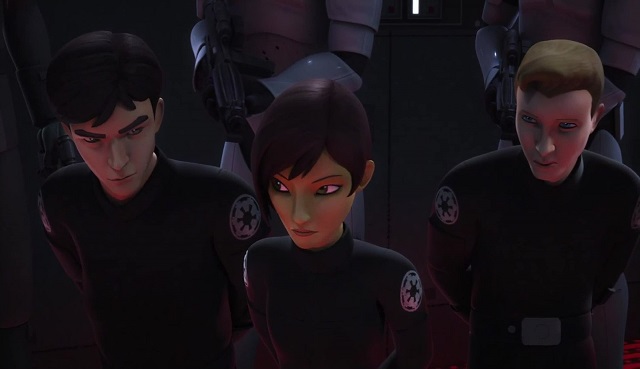
We saw one level of the Academy in Rebels’ first season, with Ezra infiltrating at the cadet level and making friends with Zare Leonis. What we see in this season with “The Antilles Extraction” is a higher-level facility, Skystrike Academy, where the best prospective pilots that the Empire has go to learn how to fly the Imperial way. Wedge, Hobbie and others are being taught to be ruthless and follow orders regardless of piddly things like regulations and morals. This follows the same lessons that the cadets in the younger Academy were learning, that personal feelings fall by the wayside in lieu of following orders.

So what do people like Wedge do? They abandon ship, try to get out before it’s too late, before they do something that will draw them in too deeply, or before the hooks the Empire puts into them take hold. Some don’t make it. A lot don’t make it. Wedge and Hobbie had Sabine there to save them, and Ezra and Kanan there to extract the trio and make their way back to safe space. Biggs made it. Crix Madine made it. But others don’t, they aren’t that lucky or skilled. Wedge’s friend Rake is unceremoniously killed by their own squadron commander, shot down to force the others to surrender. Others are recaptured and brainwashed into submission (as we saw in Servants of the Empire), becoming even more fanatic than those who still possess their own sense of judgement. Read More

How Much Technology in Star Wars is Too Much?

luke-robohand

With the recent return of Star Wars Rebels, we’ve finally been exploring the aftermath of Kanan Jarrus’s blinding last season. Kanan’s existing doubts and fears were only amplified by his handicap, and he spent months in apparent isolation before finally learning from Bendu how to use his Force senses in place of the real one he lost.

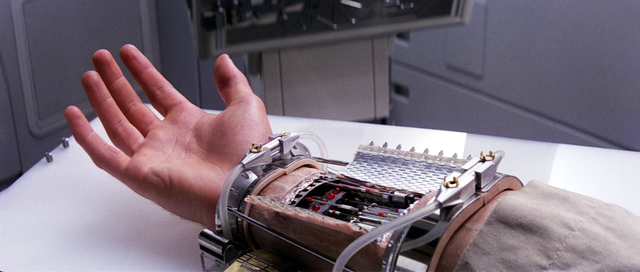
“Warrior learns how to see without seeing” is a time-honored trope that was all but made for Star Wars, and I loved seeing Rebels‘ take on it—I see the value in telling that story, not just for its own sake, but as a means of growing Kanan as a character and opening his mind to new paths. But at the same time, I admit I have a little suspension-of-disbelief issue with it: couldn’t the guy just get new eyes? Forget the ample prosthetic limb technology that we already know exists; if they can clone an entire army of dudes and age them at double their natural rate, surely they could clone him new biological eyes?

Well, maybe, but maybe not. Post-reboot, there are far fewer examples of cyborgs in Star Wars than there used to be, and the ones that we do see often are often portrayed as faulty or not quite optimal–so it’s unclear whether a robotic eye, or a cloned one, is actually possible, as counter-intuitive as that might be. The reality is, Kanan doesn’t have new eyes because that story wouldn’t be as interesting—just like Return of the Jedi wouldn’t have been as interesting if Luke had to duel with his left hand only. Read More

Rebels Revisited: “My Name is…Maul”

rr-maulghost

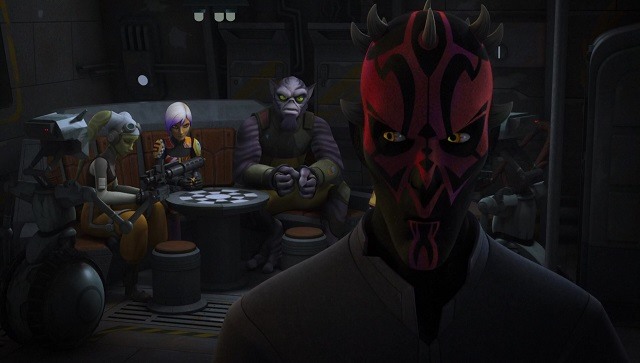
Bringing Darth Maul back to life was one of the biggest, and most controversial, changes brought to the Star Wars canon by The Clone Wars. At George Lucas’s behest, the Sith apprentice was brought back from the fate he met in The Phantom Menace, found half-crazed and ranting on a junkyard planet, only his rage and the power of the dark side keeping him alive. As TCW went on, Maul became one of the show’s strongest recurring antagonists, laying out insidious plots to try and regain his own power and to ensnare the ultimate object of his hate: Obi-Wan Kenobi.

When TCW ended its broadcast run after its fifth season, Maul’s ultimate fate was one of the plot lines that was left open-ended, after “The Lawless” brought his shared organization of criminals and Mandalorians down around him and Palpatine himself did something to his wayward apprentice, but explicitly left him alive. Following up on that, the comic series Son of Dathomir also avoided concluding his story, leaving him on the loose in a galaxy that was about to change from Republic to Empire.

Maul came back once again in the season two finale of Rebels, older but just as devious, and he once again escaped a definitive fate by fleeing his ersatz prison on Malachor. Maul’s appearance was the capstone to a season largely defined by the conflict between Ezra and Kanan and their opposite numbers on the Imperial side, where he introduced Ezra to the powers and dangers of the dark side. What stories took place in the time between then and the end of TCW are left (for the moment) to the imagination and vague hints about the “Siege of Mandalore”. Read More

Rebels Revisited: Room to Breathe

rr-thrawnpryce

Jay: The season three premiere of Star Wars Rebels was an interesting departure from the series norm. I’ve already heard a few people observe that it was less intense — both emotionally and in terms of action — than the opener of the last season, and I agree. I also think that’s a good thing: the story development reasons that required “The Siege of Lothal” to be a very harrowing experience for the characters militate a very different sort of development for the season three opener. That said, I don’t think the character experiences are any less intense just because their engagement with the villains was.

Vader loomed large over “The Siege of Lothal”. He had to — he’s Darth Vader. But more than that, he escalated and changed the stakes in a show where the Ghost crew — even facing the Grand Inquisitor and Grand Moff Tarkin — had a fairly easy time of it. He also drove the crew off of Lothal in a convincing fashion. These were all important for story reasons: it wasn’t just that Vader’s presence demanded that the heroes become overwhelmed, but that they needed an impetus to change the pace of the show and change its setting. “Siege” was exactly what the show needed, and it shocked the audience in all the right ways just as it provided the characters a great shock and opportunity for growth.

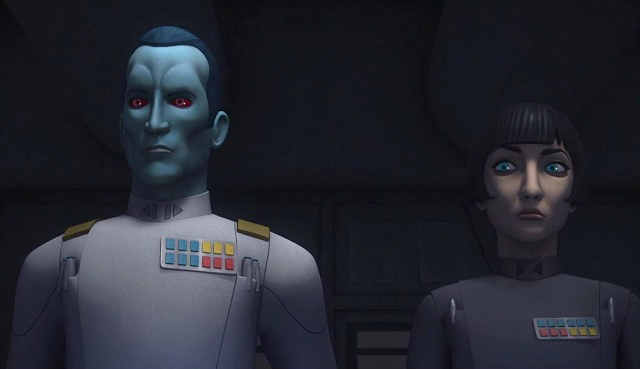
“Steps Into Shadow” was different. For one thing, it would be a little unconvincing if Thrawn were to show up and 1) be defeated or 2) defeat the Ghost crew but be prevented from finishing them off. Instead, his presence was slow and methodical — he made himself known as a threat, but in that very deliberate and methodical way that Thrawn does. As Dave Filoni pointed out in an interview, Thrawn is very different from someone like Tarkin (or the other villains that the Ghost crew has faced) — Thrawn is not a politician and he doesn’t have a need to show immediate results. He’s after the bigger picture. That alone makes him terrifying — the finality with which he dismissed the entire Phoenix force by saying, “that is not the Rebel fleet,” says it all. He’s playing to win, and that will take time. Read More