What Will You Become: Saw Gerrera and Armed Revolution

saw-whitaker

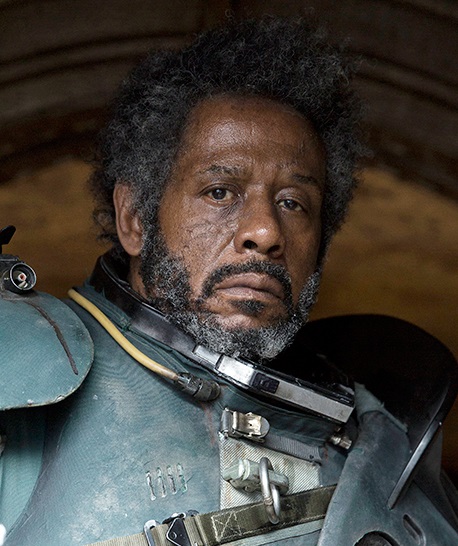
The Star Wars universe, despite originally depicting a very Manichean struggle between good and evil, has become in the decades since the original movie a very morally nuanced place. I’ve mentioned before that if I look at the current status of the franchise, I’m tempted to consider Star Wars to be more of an anti-war story than a war one, but that’s a debate that we’ve had on this website very recently. Personally, I feel that although the original trilogy no doubt romanticized armed insurgency, George Lucas’s point of view on war and violence had evolved and become considerably more pacifist by the time the prequels and The Clone Wars rolled in.

Behind the curtain of space fantasy, George Lucas told the audience about things like false flag operations, the military-industrial complex, and factionalism in insurgencies. The heroes of the story, the Jedi, lose because they get involved in war. War itself is bad. If we look at the totality of the material that Lucas himself produced under the banner of Star Wars, behind all of the heroics and the swashbuckling, it sure appears to tell us that war sucks. But is there a way to add a bit more nuance to this message without negating it? Read More
Star Wars and the Myth of Redemptive Violence: Continuing Thoughts

obi-chosenone

“Don’t read the comments”—that’s what people are always telling you about the internet, right? That being the case, I have to say that I’m enormously proud of the comments we get here at Eleven-ThirtyEight; even when there are disagreements, they tend to resolve amicably, and input from our audience often results in a deeper understanding and appreciation of the topic in question for all involved.

A couple weeks back, we published a guest piece from Andrew Berg called Star Wars and the Myth of Redemptive Violence, which considered, put simply, whether Star Wars as a franchise was contributing to (or in opposition to) the Western cultural obsession with violence as a just solution. As the days after the piece went on, a discussion continued between Andrew and two longtime ETE commenters—Eric Brown, an occasional guest writer himself, and John Maurer. I find this topic fascinating my own self, and so robust and interesting was their exchange that I eventually sought, and was given, their approval to republish the whole thing as a new piece in its own right.

This piece will also function as a special extension of the conversation if anyone else wants to weigh in further; due to an issue we used to have with spambots, I had to disable comments on pieces older than two weeks, meaning that the original is now closed for good. Here’s to continuing this excellent line of discourse. – Mike, EIC Read More

Europe 2016: A Celebration of the Lucasfilm Story Group

swce-storygroup

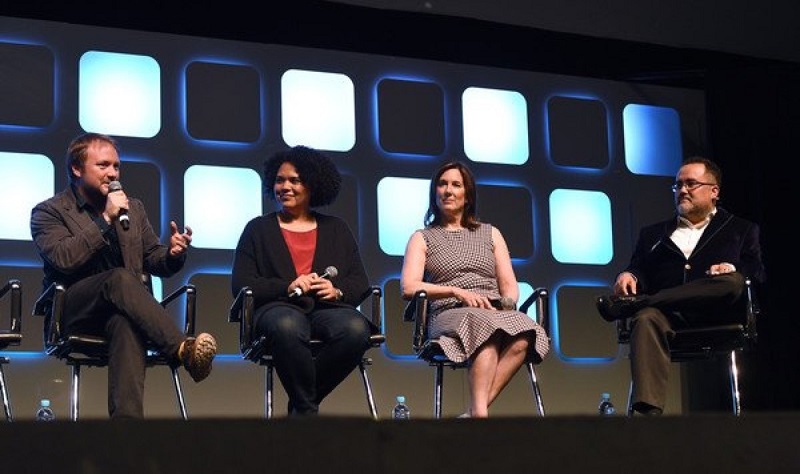
During the “Future Filmmakers” panel, the final event of Star Wars Celebration Europe 2016, Episode VIII director Rian Johnson revealed that he had spent six weeks in San Francisco with the Lucasfilm Story Group developing the story for the film before writing his screenplay. Sitting in the audience, I was at first surprised to learn this, but in retrospect I shouldn’t have been. It confirmed a feeling that had been growing with each panel I had attended throughout the weekend: that the role of the Story Group is wider, and more central to every aspect of Star Wars storytelling, than I had thought.

It is a common misconception that the Story Group exists to ensure continuity between the various media in which Star Wars stories are being told: films, novels, comics and video games. This is certainly part of their role, and we can see the fruits of that in the two most recent novels, Claudia Gray’s Bloodline (which had input from Johnson himself) and Chuck Wendig’s Aftermath: Life Debt. Both books draw together story elements spanning existing novels and films, and also give us tantalizing hints of what may be to come in the sequel trilogy. At the “Star Wars Publishing” panel on Saturday, Matt Martin from the Story Group mentioned that aspects of the Adventures in Wild Space series, ostensibly written for children, will soon make their way into stories aimed at adults. The revelation at that panel that the Rogue One tie-in novel Catalyst will be written by James Luceno also implies an intention to ensure continuity between the film and Luceno’s previous novel Tarkin, which covers the early days of the Death Star project. Read More

To Novelize or Not to Novelize—Is There Any Question?

anh-novelMike: Sometimes you can know something without really being conscious of it—and often you can be very much aware of something without fully grasping its implications. One such fact occurred to me recently: getting a new Star Wars film every year means that there is every reason to believe that we will also be getting one film novelization every year. In perpetuity.

Going off of Del Rey’s recent publishing schedule (though Disney-Lucasfilm Press adds an interesting new dimension to this), that amounts to roughly one in five “adult novels” from now on. When the prequels were coming out, there were around seven adult novels per year instead of five, and of course only one movie every three years—meaning roughly five percent of Del Rey’s output at the time was novelizations, versus twenty percent now. That’s a huge shift.

Now, I’m not here to say I want to return to seven original Star Wars novels every year. Even with the excitement of the new canon, what we’ve gotten over the last couple years has been more than enough new material to sustain my interest as a reader, while leaving enough energy for me to check off an old Legends book once in a while. My interest is strong, but my time and energy have waned as I’ve gotten older—so while I’m actually grateful that the publishing has slowed down a bit, I’m also more choosy about what I really do want to read.

And I don’t know that I want to read a new novelization every year. While most people will agree that at least one, Revenge of the Sith, was able to break out of the box of, let’s say unremarkableness, that firmly contains most novelizations, that’s only one out of seven—and The Force Awakens seemed to confirm that RotS was the exception to the rule rather than a new priority. I don’t think it was bad, it was just…unremarkable. The fact is, the basic mission statement of a novelization doesn’t demand a whole lot of an author, and plenty of good ones have failed to break out of that box, or even, seemingly, to try. I get why they exist, I don’t really expect Del Rey to stop doing them anytime soon, but—I’m seriously wondering if they’ll soon stop being worth my time. Read More

Life Debt: Redrawing the Map

battlejakku

Map? What map? Why, the only map worth talking of. That of story possibilities within this new world of Star Wars, which has just entered its third year. Life Debt came along and kicked down several doors, blew up a few sealed passages and, by way of raising merry hell, re-drew the map. How has it done this? I got together with Nick Adams, occasional Eleven-ThirtyEight guest writer, long-time contributor to Jedi Council Literature and, for his sins, Moderator, who some will know to have been the trigger for the creation of Admiral Nict in Star Wars Legacy, to bat a few ideas back and forth. Here’s what we came up with.

There are some Life Debt spoilers in this article with regard to the post-Endor war with the Empire.

Ben: Nick, you correctly commented that in the space of a year the new continuity has racked up more destruction than Legends accrued over a decade! It also got me thinking as to what this could mean for new stories.

One thing that Legends suffered from was the perception of a hierarchy of material, that the films should always be deemed top dog and nothing should undermine that status in any way. I always found that to be at odds with the idea of Star Wars being a multi-media tale. At the same time, some of the Legends stories I enjoyed most were the madly ambitious – like Dark Empire. To others, that was the poster child for what they loathed – it brought back the Emperor, had an Imperial civil war and took Force powers way, way off the scale. Similarly the X-Wing stories Iron Fist and Solo Command stood out for being ambitious enough to do fleet engagements. Read More